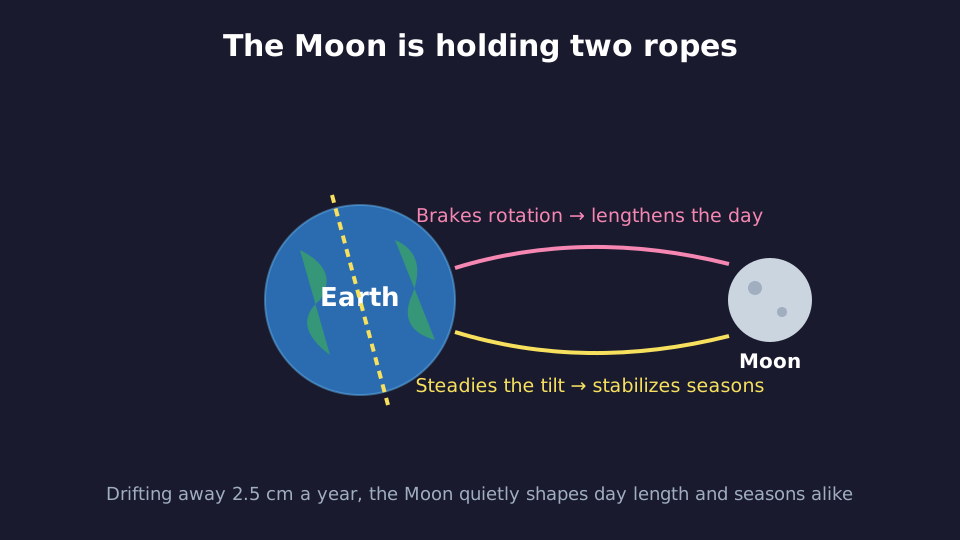
The Moon is still drifting away from us, about 2.5 centimeters a year — roughly the speed your fingernails grow. In return, Earth keeps handing over a sliver of its own spin, little by little, forever.
It’s easy to forget that the familiar Moon is running this quiet transaction every single day. And the deal covers more than ocean tides — it also keeps our seasons from spiraling out of control.
So what would actually stop if the Moon vanished overnight? Let’s walk through it.
The Moon retreats at about the speed your fingernails grow
According to NASA, the Moon sits an average of roughly 384,400 kilometers from Earth — about 30 Earths lined up in a row.
That distance isn’t fixed. NASA says the Moon drifts outward by about 2.5 centimeters (roughly an inch) every year. Left unchecked, that means a future full moon will look just a touch smaller than the ones we see today.
If the Moon were simply wandering off, that alone wouldn’t be much of a story. The real hook is what’s happening on the other side of the ledger: Earth’s rotation is slowing down at the same time, bit by bit.
In other words, our days have been stretching longer for a very long time.
I’ll admit it took me a while to realize that “the Moon drifting away” and “the day getting longer” are really two faces of the same coin. The thing that connects them is something we watch every day without thinking twice about it: the tides.
The tidal bulge is Earth’s brake pedal
The Moon’s gravity tugs at Earth’s oceans, pulling water toward it. NASA explains that this creates two bulges — one on the side facing the Moon, and one on the exact opposite side. That’s why most coastlines see two high tides and two low tides a day.
Here’s the part worth pausing on: Earth keeps spinning underneath these bulges the whole time.
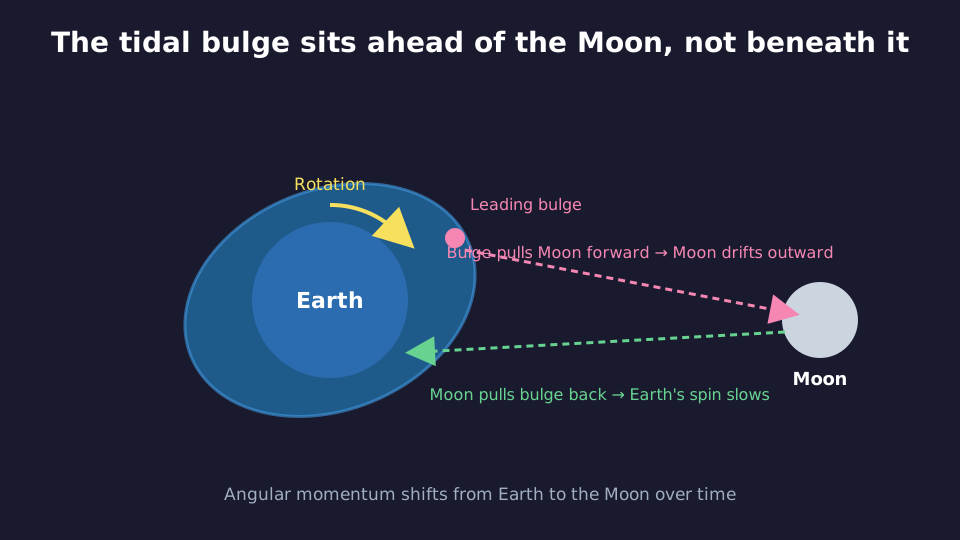
The ocean bulge can’t stay perfectly lined up under the Moon, because Earth’s rotation keeps dragging it slightly ahead of the Moon’s position. NASA notes that it takes a coastal point a bit more than 24 hours — about 50 minutes extra — to rotate back under the Moon again.
That small forward lean in the bulge turns out to matter enormously.
The offset bulge tugs the Moon forward with a little extra gravity. That nudge hands the Moon orbital energy, and the Moon edges farther out. This is the actual mechanism behind the Moon’s yearly retreat.
And every action has a reaction. While the bulge pulls the Moon forward, the Moon pulls the bulge backward — and that drag acts as a brake on Earth’s spin. The rotational momentum Earth loses doesn’t just disappear; it transfers straight into the Moon’s orbit. The total angular momentum stays the same, just redistributed from Earth to the Moon.
Here’s where it gets interesting: what happens to our days if that brake disappears?
Without the Moon, our days would have stayed short
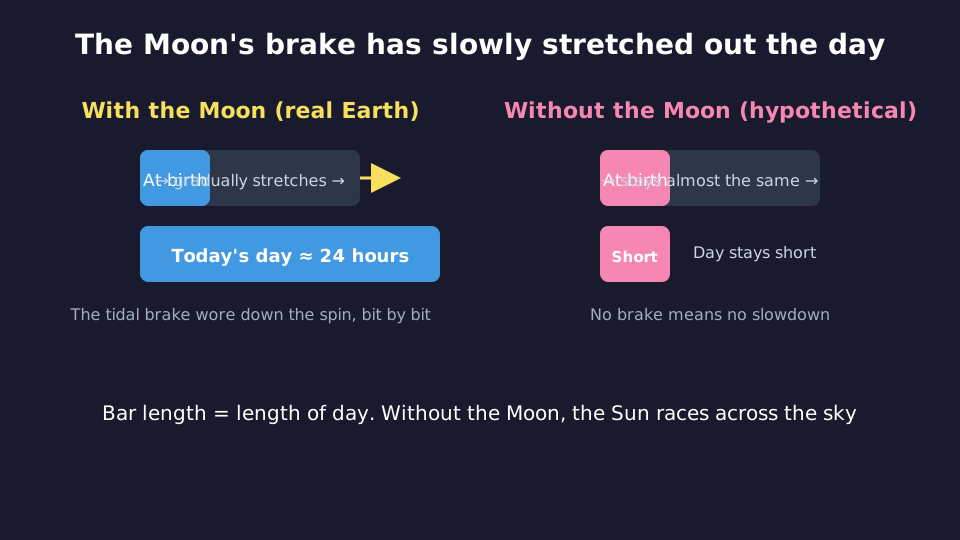
Early Earth is thought to have spun much faster than it does now. Over billions of years, the Moon’s tidal brake has gradually worn that spin down, stretching the day out to something close to 24 hours.
So imagine a version of history where the Moon never existed.
Earth would have kept spinning at close to its original, breakneck pace, and the day would be far shorter than it is now. No brake, no wearing-down of the rotation.
Picture standing on a moonless Earth: the Sun would race up, sprint across the sky, and drop again almost before you’d finished your morning coffee — noon arriving with barely any warning. A restless, hurried kind of day.
Flip that around, and the steady 24-hour rhythm we take for granted starts to look like something else entirely: the hard-won compromise from a billion-year tug-of-war between Earth and its companion.
Curious what happens in the opposite scenario — if Earth’s rotation itself ground to a halt? We cover that separately in What If Earth Stopped Spinning. Losing the brake and losing the spin produce wildly different worlds.
The Moon as a weight that steadies Earth’s axis
The Moon’s job isn’t limited to day length. It also quietly handles something heavier: the seasons themselves.
Earth’s axis tilts about 23.5 degrees relative to its orbital plane. That tilt is why sunlight hits the planet differently throughout the year, giving us spring, summer, fall, and winter. NASA confirms it’s this tilt — not our distance from the Sun — that drives the seasons.
The key detail is that this 23.5-degree angle has stayed remarkably stable over long stretches of time.
Earth behaves something like a spinning top, and spinning tops naturally want their axis to wander. Gravity from the Sun and other planets constantly tries to nudge that wobble along, but the Moon’s gravity acts as a steadying weight nearby, keeping the tilt from swinging wildly — researchers’ models show the Moon has played exactly this stabilizing role.
Personally, I think this is the Moon’s most underrated job. It doesn’t have the drama of crashing waves, but it’s quietly propping up the foundation of our climate.
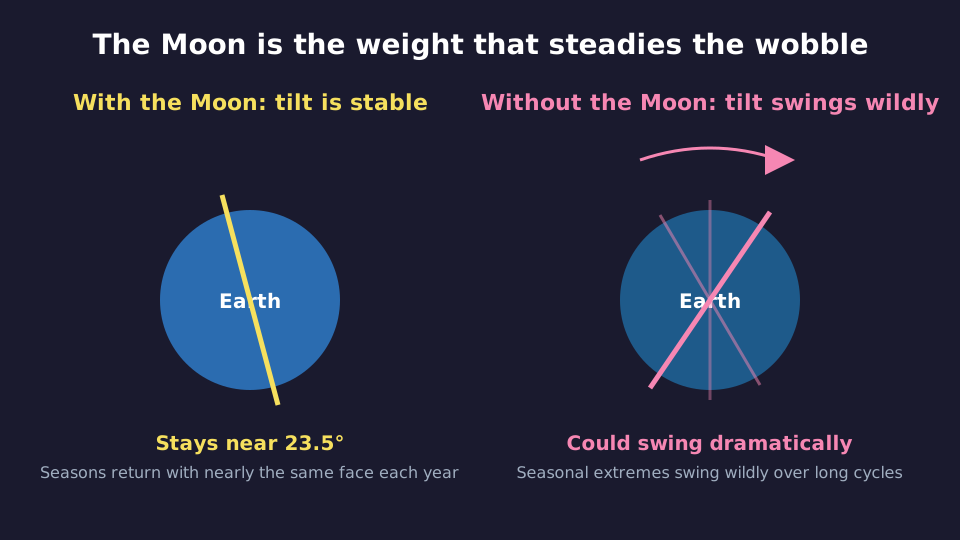
What it actually means for seasons to “spin out of control”
So what happens if that weight gets removed?
Models show that a moonless Earth’s axis could wander much more widely over long timescales — not just a few degrees, but potentially a dramatic swing. Planets without a large moon are thought to experience big, long-term tilt variation, and Earth could well have joined that club.
Change the tilt, and you change how sunlight gets distributed across the whole planet.
Push the tilt much higher than today’s, and summers would bake the poles under a high sun while winters plunge the same spots into long darkness — the gap between peak summer and deep winter growing far more extreme than anything we experience now. Push the tilt toward zero instead, and the seasons would flatten out almost entirely, leaving nearly the same sunlight everywhere, year-round.
The tricky part is that this kind of shift unfolds over thousands or tens of thousands of years, and irregularly at that — the climate never gets a chance to settle into a rhythm. For life, and for any civilization trying to keep a calendar, a world like that would be brutally hard to live in.
The fact that we can count on “roughly the same season, roughly on schedule, every year” isn’t a given. It’s the sky’s counterweight doing its job.
What the familiar Moon is really holding onto
Put it all together, and the Moon is gripping two ropes at once: one that slowly brakes Earth’s rotation through the tidal bulge, and one that braces the planet’s tilt like a gravitational counterweight.
Take the Moon away, and the day would stay short forever, while the seasons would drift into chaos over time. The calm, steady 24 hours we live by — and the four seasons that return with nearly the same face every year — were never free.
Next time you look up at the Moon, remember that the pale disk up there is quietly inching away, about 2.5 centimeters a year — roughly the pace of a trimmed fingernail. And with every bit of that distance, it’s still handing Earth the length of its day.
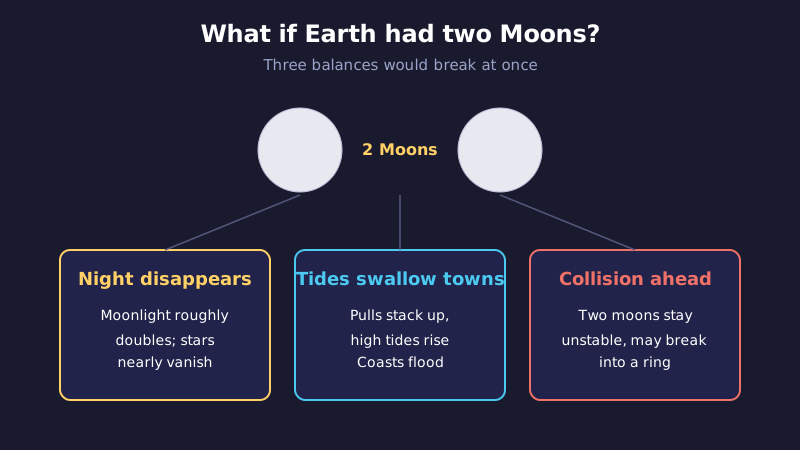
We’ve also run the opposite thought experiment — what if Earth had two moons instead of one? That’s in Earth With Two Moons. Whether it’s one moon or two, the distance between a planet and its satellite turns out to be a remarkably delicate balance.