Picture tonight’s full moon. Now picture a second one, just as bright, hanging right beside it. The sky fills with two silver disks, and even at night your shadow falls sharp and clear.
That would be a gorgeous sight, if it stopped there. But the moment that picture becomes real, Earth’s oceans start acting up every single day. And the two moons themselves won’t get along for long.
Night would basically stop existing
On a full-moon night, you can see your feet even without streetlights, because moonlight — reflected sunlight, really — is surprisingly strong. You could read a newspaper headline by it.
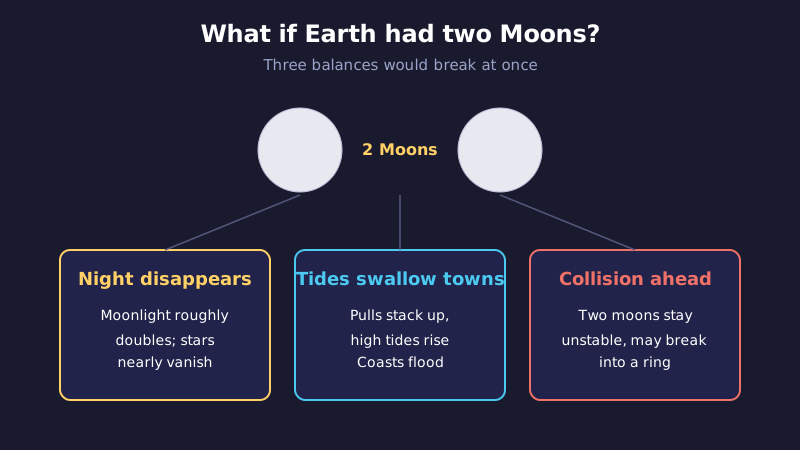
Add a second full moon of equal brightness, and you roughly double the light hitting the ground. Shadows deepen, and the stars mostly wash out. It’s the same effect as city light pollution, except now the whole sky is doing it to itself.
Here’s the catch: the two moons wouldn’t always be full at the same time. One might be full while the other is a half-moon, which means a night with neither moon shining becomes the rare exception rather than the rule.
I’ll admit my first thought was “wouldn’t constant moonlight be kind of convenient?” But night is when most living things rest, and migratory birds and sea turtles steer by moonlight. Give them two moons to choose from, and which one are they supposed to follow?
There’s a stranger side effect, too. Our actual Moon happens to look almost exactly the same size as the Sun from Earth, which is why a solar eclipse works — the Moon slides precisely in front of the Sun and blacks it out. With two moons, you’d simply get more chances for that to happen. You’d also get eclipses between the moons themselves, one sliding into the other’s shadow. The sky would turn into a much busier show.
Under a sky that barely ever goes dark, ecosystems would quietly come apart. And that’s only the beginning.
The sea would climb into town every day
This is the part that actually unsettles me. The Moon’s biggest job isn’t lighting up the night — it’s running the tides.
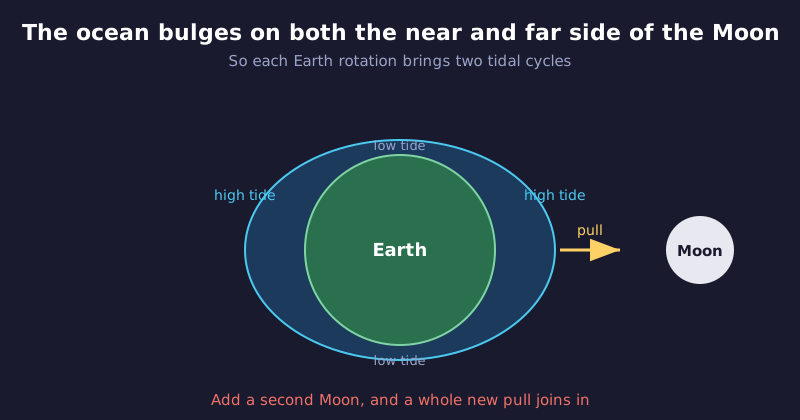
NASA explains that the Moon’s single largest effect on Earth is generating ocean tides. Its gravity tugs on seawater, causing the ocean to bulge both on the side facing the Moon and on the opposite side. As Earth spins once a day, coastlines pass through those two bulges, which is why most places see two high tides and two low tides daily.
Even today, tide heights aren’t constant — the Sun tugs on the ocean too, just more weakly. When the Sun and Moon line up, their pulls combine: high tides climb higher, low tides drop lower. That’s a spring tide, and it’s more extreme than the “neap tide” you get when the Sun and Moon are at right angles.
Now add a whole second moon. That’s an entire extra set of gravitational pull. If both moons line up in the same direction, you get a tide well beyond anything spring tides produce today.
Run the numbers. Take a coastline where the normal gap between high and low tide is about two meters. Blow that gap wide open, and low-lying port towns and tidal flats would find themselves underwater on a near-daily basis. Low tide, meanwhile, would pull back far enough to expose stretches of seafloor you’d never normally see.
The real headache is that the two moons would travel the sky on different schedules. The high tide caused by one would drift in and out of sync with the high tide from the other. Some days you’d get several small tidal swings. Other days, the two would line up perfectly and produce one enormous tide. Tide tables would become a lot harder to read than they are now.
If you lived in a house by the sea, checking the tide chart would matter more than checking the weather. Will today’s high tide stop at the front door, or come up over the floor? You’d need to track both moons’ positions every morning before heading out.
Two moons can’t share an orbit peacefully
A natural question follows: is it even physically possible to keep two moons up there in the first place?
Short answer: not easily. Each moon orbits Earth while also tugging on the other through its own gravity. Two large satellites sharing nearby orbits nudge each other’s paths slightly every time they pass.
Researchers who model orbital mechanics point out that systems like this tend to be unstable over long timescales. One moon gradually pushes the other off course, and eventually their orbits cross. Each individual nudge is tiny, but tiny nudges repeated thousands or millions of times add up.
A decent comparison is two people turning a jump rope at once. Keeping both ropes spinning without tangling takes relentless, perfectly matched timing. Space has no one managing that timing for you.
To be fair, if one of the moons were much smaller, the effect would shrink. Mars has two moons, but they’re both lumpy rocks only a few to about 20 kilometers across — nothing like a proper round moon. Having “two full-moon-sized bodies orbiting an Earth-sized planet” is simply a tough ask from the start.
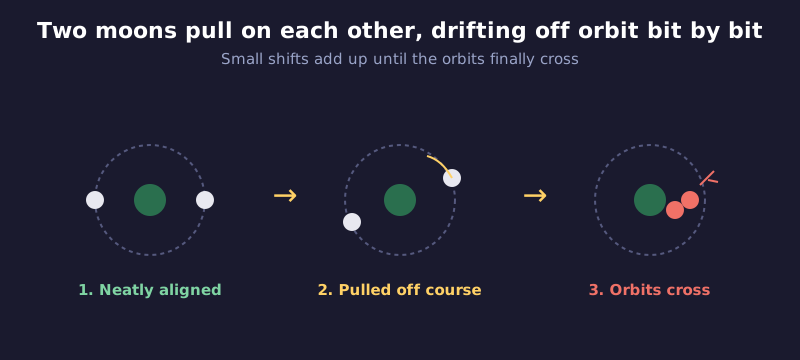
So an “Earth with two moons” — even if it starts out perfectly arranged — is really just a temporary phase. It won’t last. Which raises the next question: what happens once those two orbits cross?
After the collision, Earth might end up with a ring
When two moons get too close, they don’t simply crash and stop there. Near a massive body, a stretching force called tidal force — the difference in gravitational pull between the near side and far side of an object — starts to act with real violence.
Cross inside a certain distance, and that stretching force overwhelms the moon’s own gravity holding it together. The moon can no longer stay in one piece; it shatters into a belt of debris.
Once that debris starts circling Earth, the resulting shape would look familiar. It’s basically Saturn’s rings — a flat disk made of countless shards of ice and rock, thought to be the leftovers of a shattered body.
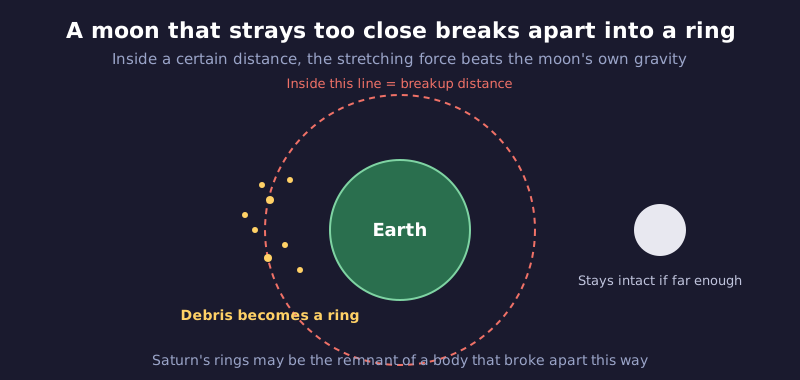
Imagine it: after the collision, Earth’s sky no longer has a second moon. Instead, a thin band of light rises from the horizon, arcing overhead day and night.
That band would change with the seasons and the hour — darkening when it slips into Earth’s shadow, glowing white when it catches full sunlight. Humans have spent millennia writing poems and myths about the night sky; a civilization born under a ringed Earth would surely have spun entirely different stories from that arc of light.
That said, this is all speculative. Depending on the angle and speed of the collision, a lot of that debris could just as easily rain down onto Earth instead. A beautiful ring, or a meteorite storm — nobody can say for certain which.
One moon turns out to be just right
By this point, having only a single moon in the sky starts to look remarkably convenient.
According to NASA, the Moon sits an average of about 384,400 kilometers from Earth. Its radius is roughly 1,740 kilometers — less than a third of Earth’s own width. It’s a size and distance that lands in a kind of sweet spot: not too far, not too close, not too big, not too small.
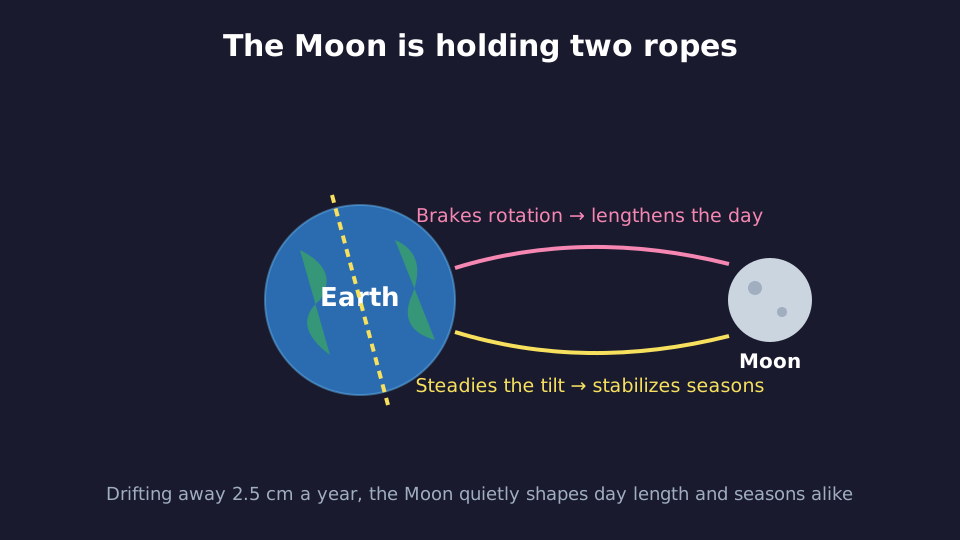
That one moon is also thought to act like a stabilizing weight for our planet. Researchers have long argued that the Moon keeps Earth’s axial tilt — currently about 23.4 degrees — from wobbling wildly. A steady tilt means steady, predictable seasons.
And this same Moon is still drifting away, little by little, every year. NASA notes that it’s receding from Earth by about an inch, roughly 2.5 centimeters, annually — about the speed your fingernails grow. Slowly, steadily, it’s headed farther out.
If the axial tilt ever went haywire, the seasons could swing wildly from year to year — a brutal heat wave one year, a long deep freeze the next. The mild, predictable seasons we take for granted may well owe their existence to that one moon acting as a counterweight.
Even a single, slowly departing moon generates tides, lights up the night, and holds the axis steady. Add a second one, and the oceans go haywire while the sky eventually comes apart. More, in this case, was never going to be better.
Next time you look up at a full moon, remember: that single silver disk isn’t an arbitrary number. It’s a razor’s-edge balance that doesn’t work with one more, or one less.