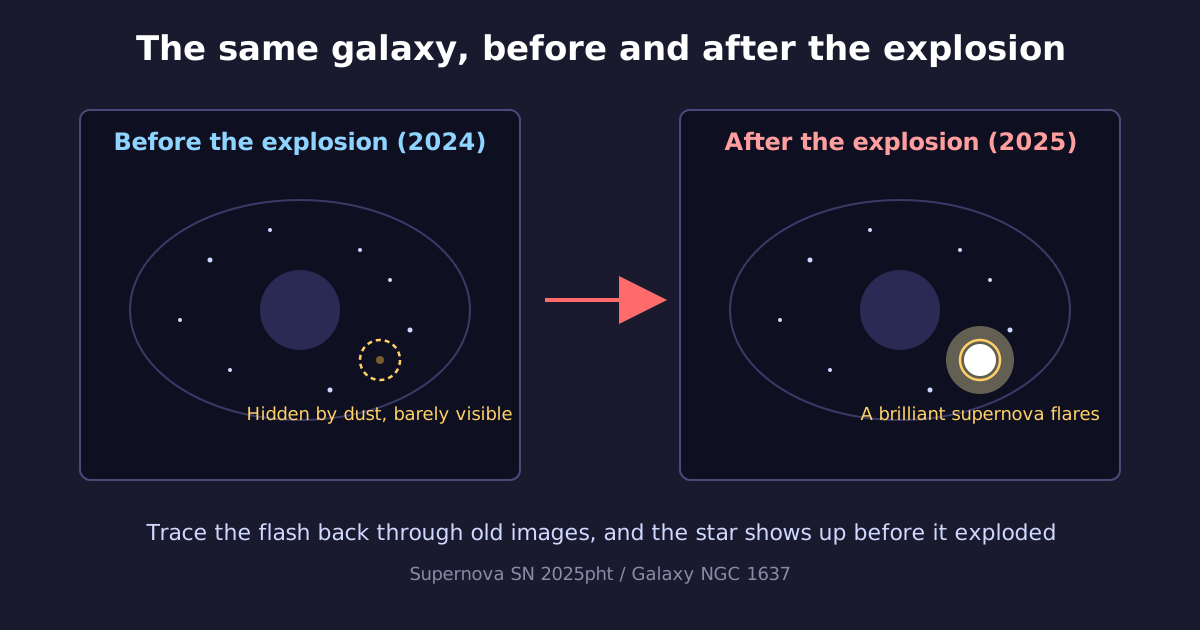
On June 29, 2025, a star exploded 40 million light-years away. Astronomers called it supernova SN 2025pht. The first thing researchers did after hearing the news wasn’t pointing a new telescope at it. It was digging through old photo albums.
Searching for a star before it exploded, after it already exploded, sounds backward. But in astronomy, it’s a standard part of the investigation.
And this time, something unexpected turned up. The star that Hubble never managed to catch before the blast showed up perfectly in Webb’s images.
After the event, astronomers reach for the old photo album
A supernova is the final, violent act of a massive star’s life. For a few weeks, it can outshine an entire galaxy. Spotting one isn’t hard. The hard part comes afterward.
Astronomers want to know which star blew up. But a galaxy holds countless stars, and once one of them flares, all you see is a single bright point. The star’s original identity is gone.
This is where a quiet telescope habit pays off. Both Hubble and Webb photograph the same patches of sky, the same galaxies, over and over across the years, and they keep every image. Think of it as a vast photo album of the sky.
So when something explodes, astronomers note the coordinates of the flash and flip back through that album to check what used to sit at that exact spot. It’s not unlike rewinding security footage after a break-in.
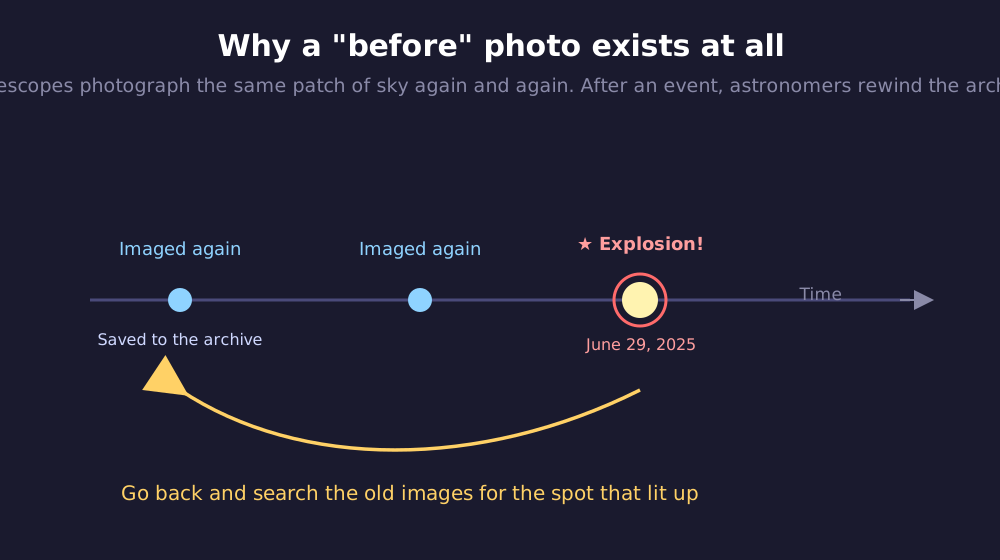
Here’s the interesting part: this method doesn’t work because anyone predicted the explosion. It works because routine, almost boring, repeat photography happens to double as evidence down the line.
Lining up the exact same point, before and after
But where in the old images do you even look? Among countless stars, you need to identify exactly one.
The trick is alignment. Take the coordinates of the point that flared up, then overlay the earlier image on that same spot. Whatever was sitting there before the explosion is the culprit. Astronomers call it the “progenitor” star.
A useful comparison is an old group photo. Someone goes missing, so you dig up a group photo from years back and trace who was standing in that exact spot. That’s close to what’s happening here.
The technique itself isn’t new. Back in 2017, when supernova SN 2017ein went off in the galaxy NGC 3938, about 65 million light-years away in the direction of Virgo, researchers traced the explosion site back to a Hubble image taken in 2007 and identified a candidate star. That’s a ten-year-old photograph settling the question.
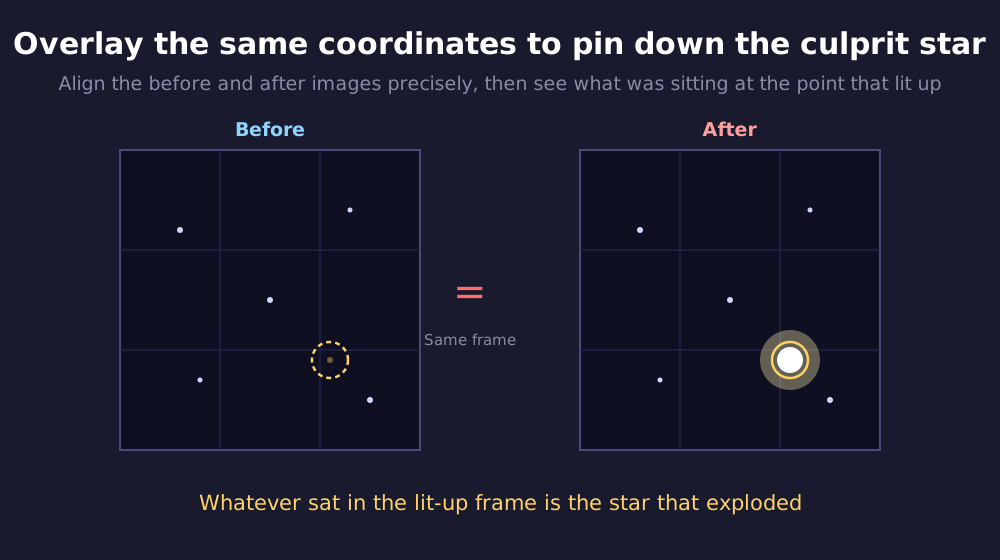
This might sound like a technical detail, but skip it and nothing that follows makes sense. Lining up “before” and “after” is the only bridge connecting a star’s death to its identity.
But Hubble hadn’t photographed any star there
Investigators followed the same playbook for SN 2025pht. Hubble had already photographed the spot where the progenitor star should be, back in August 2024.
Except there was no star in the picture. When researchers overlaid the explosion site on Hubble’s older image, the location looked essentially empty.
That’s a real problem. The procedure worked exactly as it was supposed to, but the one thing the album needed to show wasn’t there. If even a faint candidate star had shown up, its brightness and color could tell you what kind of star it was. With nothing visible, there was nothing to work from.
So why was it invisible? According to NASA and the research team, the star turned out to be sitting in an unexpectedly thick cloud of its own dust. The star had spent years shedding material around itself, and that dust was blocking the visible light — the ordinary light our eyes can see — before it ever reached the camera. The star was there all along. It was just standing behind a curtain Hubble couldn’t see through.
Honestly, this is the detail that turned the investigation from routine into genuinely interesting. The evidence should have been right there, and it wasn’t. It’s the mystery-novel moment where the one photo you actually need comes back completely black.
A second look, with light that cuts through dust
This is where Webb comes in. Webb specializes in infrared light — invisible to our eyes, but with a longer wavelength than visible light.
Longer wavelengths are much better at slipping past dust. Visible light scatters off tiny dust grains and gets blocked, but infrared light can thread its way through the gaps. It’s the same principle behind why a car’s headlights still reach you faintly through fog, even when nothing else does.
As it happened, Webb had already photographed this galaxy, NGC 1637, before the explosion — in October 2024, using its Near-Infrared Camera (NIRCam) and Mid-Infrared Instrument (MIRI). That’s roughly eight months before the star blew up.
Looking at that same patch of sky again, there it was: a red supergiant, invisible to Hubble but clearly present in Webb’s infrared data. Red supergiants are the swollen, late-life stage of massive stars, and astronomers have long known that stars like this are prime candidates to end their lives as core-collapse supernovae.
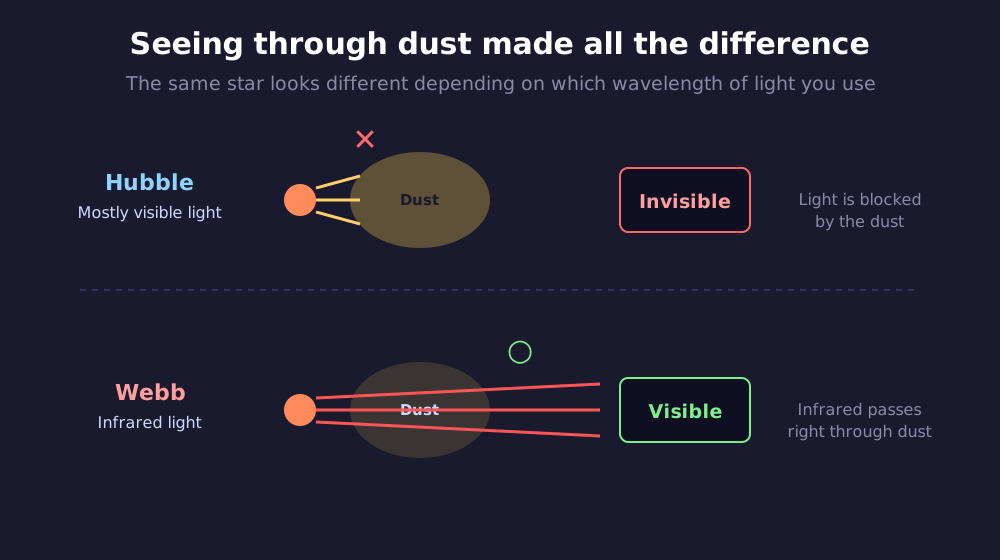
One member of the research team described this star as “the reddest, dustiest red supergiant we’ve ever seen explode.” The dust itself, researchers reported, was unusually rich in carbon. The same star, seen in different colors of light, can either vanish completely or stand out clearly — rarely has that contrast been this stark.
What a “before” photo is actually good for
Why does catching even one image of the progenitor star matter so much?
Plenty of supernovae have been observed after the fact, lighting up and fading away. But directly linking “this specific star” to “this specific kind of death” has always been much rarer. Only once you know a progenitor’s mass, temperature, and how much dust it was carrying can you check your theories about stellar life and death against reality. It’s essentially a portrait of someone taken before they died. And when a star this heavily wrapped in dust turns up, it also hints at what massive stars are shedding into their surroundings right before they go.
This case marks the first published progenitor detection for a supernova made using Webb, according to NASA.
Lead author Charlie Kilpatrick of Northwestern University put it simply: his team had been waiting for a supernova to go off in a galaxy Webb had already observed. The results were published in The Astrophysical Journal Letters.
It’s worth pausing on one thing. In October 2024, when Webb photographed this galaxy, nobody knew that one particular point in that image would explode eight months later. It was just another frame packed with ordinary-looking stars. If you want to dig deeper into how a star’s life unfolds, check out what a star’s color reveals about its lifespan and what the sun’s own ending will look like.
Tonight’s sky photo could be tomorrow’s answer key
Forty million light-years is a staggering distance. Light from this star took 40 million years to reach us. The explosion we’re seeing happened before humans existed on Earth in any form. And out of that already-ancient light, astronomers dug even further back to recover the star’s life before death. It’s a double rewind through time.
What makes that possible isn’t some dramatic, one-off effort. It’s the unglamorous habit of photographing the same patch of sky, night after night. Somewhere tonight, a telescope is quietly imaging an unremarkable galaxy. Somewhere in that frame, a star that will explode years from now might already be sitting there, looking perfectly ordinary.
That’s how the sky’s photo album keeps getting thicker, one page at a time.