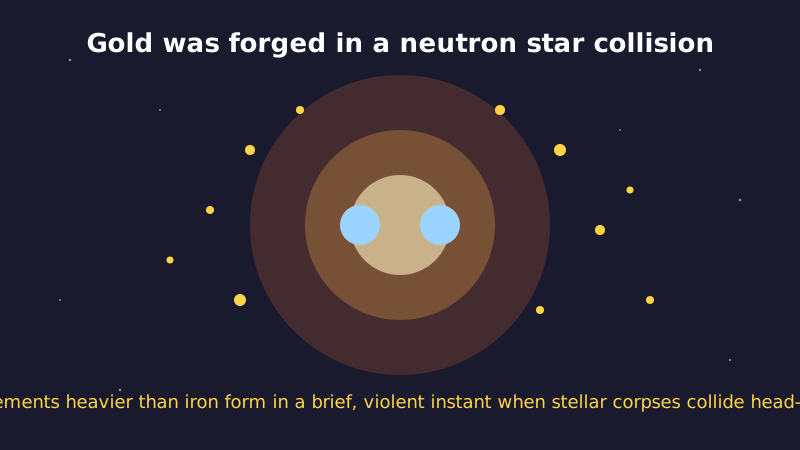
Say there’s a gold ring on your finger right now, or tucked away in a drawer somewhere. Trace one of its atoms back to its birthplace, and you won’t end up inside a calm, Sun-like star.
You’ll end up in a few seconds of hell, at the moment two dead stars slammed into each other.
Gold and platinum can’t be made, not even a single atom’s worth, inside an ordinary star. That’s not a metaphor. It’s physics.
Why Stars Can’t Make Gold
A star shines because its core is fusing light atomic nuclei into heavier ones, a process called nuclear fusion. In the Sun, that means turning hydrogen into helium, which releases the heat and light we see.
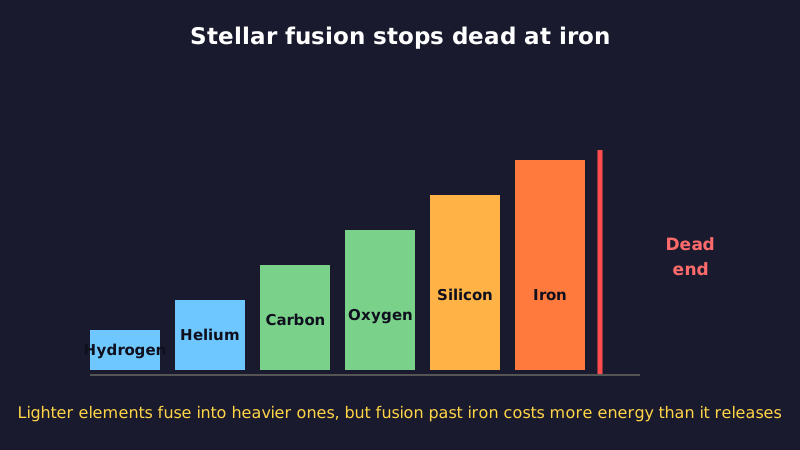
In heavier stars, that chain of reactions keeps climbing. According to NASA, carbon fuses into oxygen, neon, and magnesium, and eventually silicon fuses into iron.
And then the process simply stops.
I’ll admit it: for a long time, I assumed a star could cook up any element it wanted, given enough time. That’s not how it works. Push past iron, and the reaction stops releasing energy and starts consuming it instead. For a star, that’s a losing trade. So the fusion ladder ends right there, at iron.
That explains a bit more than half the periodic table, up through iron at atomic number 26. The puzzle is everything heavier: gold at 79, platinum at 78, and the rest of that upper tier. If stars can’t build them, who did?
Past Iron, It’s Not Addition. It’s a Flood of Neutrons
Making something heavier than iron calls for a different strategy altogether. Instead of smashing nuclei together, you bombard a nucleus with neutrons, particles with no electric charge.
Because neutrons are neutral, they can slip straight into a nucleus without being repelled by its positive charge. Pack enough neutrons into an iron nucleus, one after another, and it just keeps getting heavier.
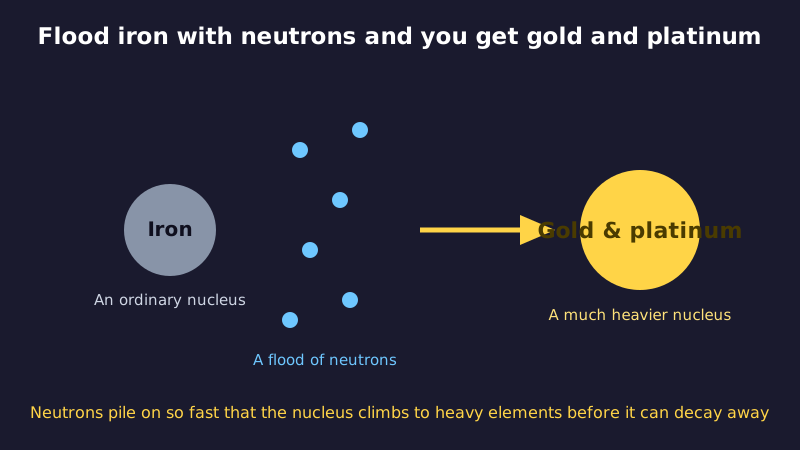
There’s a catch, though. A neutron that’s just been captured doesn’t sit still forever; left alone, it decays into something else before long. Add neutrons too slowly, and the nucleus falls apart before it ever reaches the heavy elements.
Speed is the whole trick. Flood a nucleus with neutrons faster than decay can keep up, and it rockets up the periodic table in one go. Astrophysicists call this the r-process, short for rapid neutron capture. Gold and platinum are what’s left when that climb finally stops.
So, where in the universe is there enough spare neutrons to outrun decay on that scale?
Neutron Stars: More Mass Than the Sun, Packed Into the Width of a City
The answer lies in a star made of nothing but neutrons: a neutron star.
Stars roughly 8 to 20 times the Sun’s mass end their lives when the core collapses under its own weight, triggering a supernova. What’s left behind is a core so compressed that its atoms have been crushed into a solid ball of neutrons.
The scale of that compression is almost absurd. According to NASA, a neutron star packs more mass than the Sun into a sphere roughly the width of Manhattan Island.
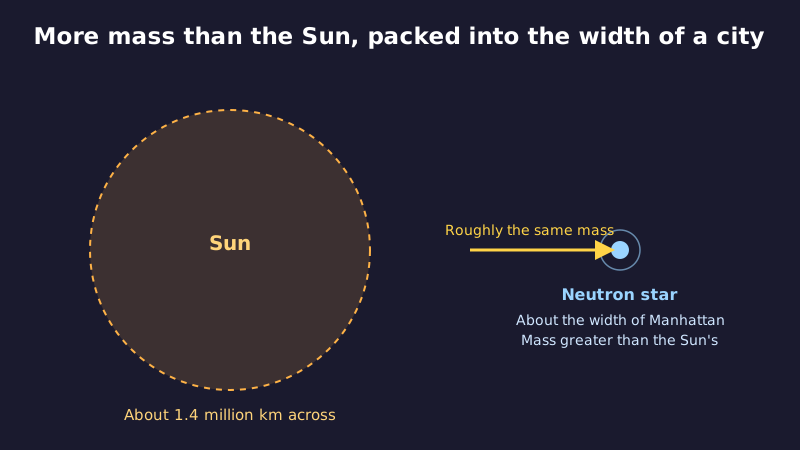
When I first read that comparison, I figured it had to be a typo somewhere. The Sun is 1.4 million kilometers across, a body you could spend decades crossing on foot, and this is squeezing that same mass down to an island you could walk in minutes.
Inside, it’s quite literally an ocean of neutrons. Everything the r-process needs, a supply of neutrons so dense that decay can’t keep up, exists there in quantities equal to an entire star.
But a neutron star just sitting there doesn’t release any gold into the universe. Water in a sealed container doesn’t go anywhere either. You need something catastrophic to spill that neutron ocean out into space.
August 17, 2017: Two Dead Stars Collided
Humanity has only caught that event happening once.
According to NASA, on August 17, 2017, two neutron stars that had been orbiting each other as a pair finally merged. It happened in a galaxy called NGC 4993, in the direction of the constellation Hydra, roughly 130 million light-years from Earth.
Two completely different signals captured the merger at once. One was a ripple in spacetime itself, a gravitational wave, picked up by the LIGO and Virgo detectors. The other was a burst of gamma rays, caught almost simultaneously by NASA’s Fermi satellite. It was the first time astronomers had ever observed the same cosmic event in both gravitational waves and light. (You can read more about that breakthrough in our piece on the new era of gravitational-wave astronomy.)
Fermi’s flash went out to astronomers worldwide almost instantly, flagged as a short gamma-ray burst. Researchers then combed through the gravitational-wave data to narrow down a patch of sky, and within 12 hours of the detection, ground-based telescopes had pinpointed the merger’s light inside NGC 4993. Only by matching three wildly different signatures, a warp in spacetime, a gamma-ray flash, and visible light, could scientists be certain they were looking at one single collision.
The two stars that merged each weighed somewhere between 1.1 and 1.6 times the Sun’s mass, despite being no wider than Washington, D.C. In their final moments, they spiraled around each other hundreds of times per second before finally colliding.
At the moment of impact, part of that neutron ocean sprays out into space. And in the debris, surrounded by more neutrons than decay can possibly keep pace with, the r-process ignites. Iron, gold, platinum: they’re all forged right there, on the spot.
The Way the Light Faded Was the Proof Gold Had Formed
Here’s where it gets interesting. Researchers never actually watched gold being forged up close. Instead, they read the evidence for heavy-element formation from a faint afterglow called a kilonova, which lights up in the merger’s wake.
Freshly made heavy elements are radioactive, decaying while still unstable and releasing heat as they go. NASA’s explanation holds that the visible and infrared light from a kilonova comes from exactly that, the heat released as this neutron-rich debris radioactively decays.
In other words, that faint glow is literally the residual heat of newly forged heavy nuclei falling apart. Watching a kilonova means watching the afterglow of gold being hammered into existence. Track the color of that light carefully, and how it fades over time, and you can work backward to figure out how much heavy material actually formed. The way the light dies down is the physical evidence that gold was made.
So observatories mobilized en masse. NASA’s Swift satellite spotted a bright ultraviolet source. The Hubble Space Telescope began capturing near-infrared spectra on August 22, reading the motion and chemical makeup of the debris. Chandra detected X-rays nine days later.
The Spitzer Space Telescope observed at the longest infrared wavelengths on September 30. That particular light tells researchers exactly how much heavy material was produced. As one researcher involved put it, Spitzer would deliver the final verdict on how much gold had been forged.
How much gold does a single merger actually produce? Pinning down that number was a central goal of the whole observing campaign: work backward from how the star’s glow faded to calculate the weight of gold it left behind.
Where Did Your Gold Actually Come From?
Let’s bring this back to the ring on your finger.
Earth’s gold was already mixed into the cloud of gas and dust that would become the solar system, long before our planet existed. That gold was scattered by ancient neutron star collisions and the explosions of massive stars, then drifted through space for ages before it ever reached us. Supernova dust, for that matter, is still raining down on Earth today (see our article on supernova dust and the local interstellar cloud).
Every single atom of gold in that ring, in other words, is debris from a star that died somewhere in a distant galaxy. What’s catching the light on your finger is older than the Sun itself, a final fragment of a star’s death.
Next time you spot a piece of gold, lean in a little closer. That soft yellow glow traces a straight line back to one single instant, 100 million light-years away, when two stars collided and tore each other apart.


