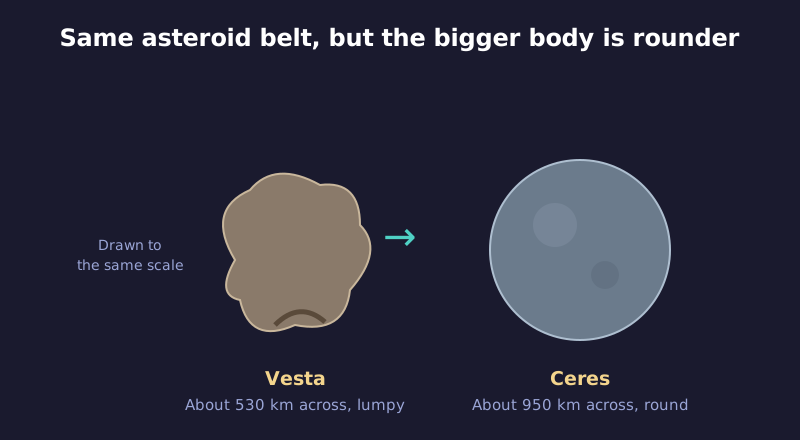
The asteroid Vesta is about 530 km across — roughly the distance from Tokyo to Okayama, turned into a single rock. That’s a sizable chunk of real estate. And yet it’s a mess: lumpy, craggy, nowhere close to round.
Compare that to Mimas, one of Saturn’s moons, which measures about 394 km across — noticeably smaller than Vesta. Despite that, Mimas is nearly a perfect sphere.
So the smaller body is the round one, and the bigger body is the lopsided one. That reversal seems backward at first. But chase it down, and it explains why worlds are round in the first place.
There’s a sharp line between “potato” and “sphere”
Line up the solar system’s bodies by shape, and they split cleanly into two camps.
One camp is the lumps: asteroids. According to NASA, asteroids range from Vesta, the largest at roughly 530 km across, down to fragments barely 10 meters wide. The smaller ones look like potatoes, or chunks of broken rock — all edges, no symmetry.
The other camp is spheres: planets and large moons. Earth, the Moon, Mars — seen from a distance, they’re all nearly perfect circles in silhouette.
What’s striking is that there’s an actual boundary here, not a gradual fade. Cross a certain size threshold, and a body becomes round, reliably, almost like clockwork. Stay under it, and the body remains a potato indefinitely. Small bodies aren’t lumpy because they’re unfinished or defective — they’re lumpy because nothing has smoothed them out yet.
So what draws that line?
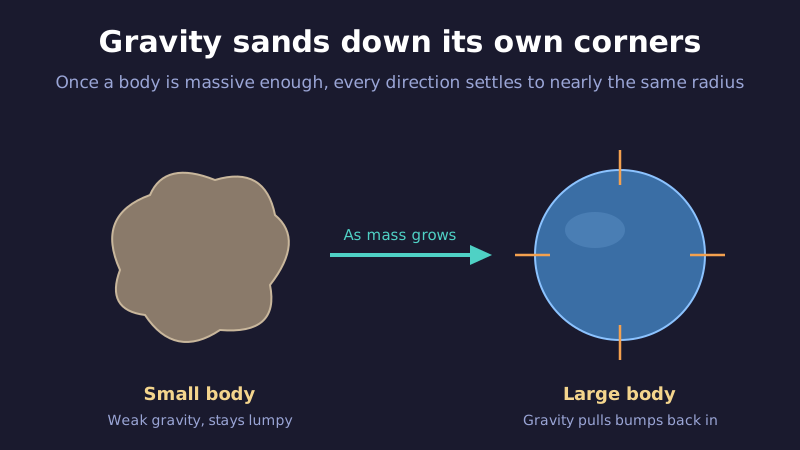
Gravity sands down its own corners
The answer is gravity — specifically, the body’s own gravity.
Gravity pulls matter toward a body’s center. And it does so evenly, from every direction: above, beside, at an angle, it’s all aimed inward. That “every direction points to the center” property turns out to be the whole trick behind roundness.
Imagine a large bump sticking out somewhere on a body’s surface. That bump has extra material piled up beneath it. Gravity tries to drag that excess mass back down. Meanwhile, material from the surroundings flows in to fill any low spots.
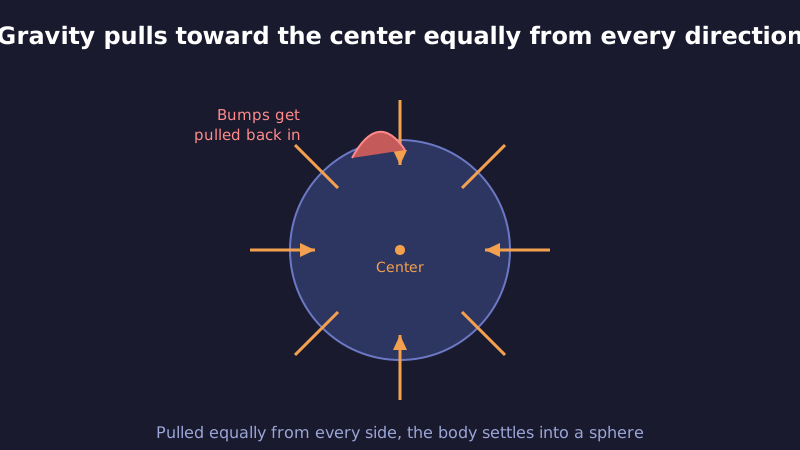
High points erode; low points fill in. Keep that going long enough, and every direction ends up at roughly the same distance from the center. A set of points all equidistant from a center — that’s the definition of a sphere.
This state, where gravity and the internal pressure of the material finally balance out and the shape stops changing, is called hydrostatic equilibrium. The name sounds technical, but the idea is simple: the body’s own weight files down its own corners until everything levels out, the way water settles flat.
A water droplet is round because of surface tension. A planet is round because of gravity. The scales couldn’t be more different, but in both cases, something refuses to leave a bump alone, and the result settles into the least strained shape possible.
Honestly, learning this changed the way I look at round worlds. That sphere wasn’t born round — it became round by grinding itself down.
Round only wins once the material gives up fighting back
Naturally, this brings back the original puzzle. If gravity is so eager to round things out, why do asteroids stay lumpy forever?
Because gravity has an opponent. Against gravity’s pull, rock pushes back with its own structural strength — its resistance to deformation. Rock is stiff, and stiff material holds its shape. That resistance is what material scientists call strength.
In a small body, gravity is weak. The inward pull simply isn’t strong enough to beat the rock’s strength. Bumps stay put; corners stay sharp. That’s why asteroids can remain potato-shaped for billions of years without anything changing.
As a body gets bigger and heavier, the pull toward its center gets stronger too. Past a certain size, gravity finally outmuscles the rock’s strength. From that point on, no bump can support its own weight, and everything gradually smooths out.
Vesta is thought to sit right at the edge of that threshold. NASA describes Vesta as having “features that are intermediate between a planet and an asteroid.” Near its south pole sits Rheasilvia, a massive impact basin roughly 500 km wide — nearly 95% of Vesta’s own diameter.
At some point, Vesta’s interior melted enough for heavy iron to sink toward its core while lighter rock floated outward. It looks like a body that started down the road to becoming a planet, then stalled just short of going fully round.
Where that line falls depends on what a body is made of
So what’s the actual number — where exactly does that threshold sit? This is, to me, the most interesting part.
There isn’t one fixed number. The boundary moves depending on what a body is made of. The key variable is the difference in hardness between rock and ice.
Rock is stiff and resists deformation strongly, so gravity needs a genuinely massive, heavy body to beat it. Ice is a different story — far softer and more pliable than rock. Even modest gravity is enough to deform it gradually.
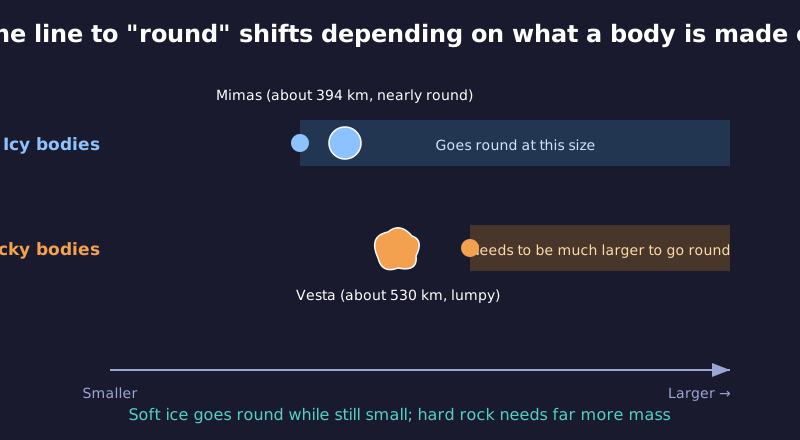
Which brings us back to Vesta and Mimas. Vesta is a rocky body, and despite being roughly 530 km across, it’s still lumpy and irregular — because rock’s strength is still winning the fight against gravity at that size.
Mimas is mostly ice, and at only about 394 km across — smaller than Vesta — it’s nearly round. Soft ice simply gives in to a gravitational pull that wouldn’t make a dent in solid rock.
Even so, Mimas isn’t a perfect sphere. NASA notes that Mimas is “a bit too small to maintain a perfectly round shape,” leaving it slightly elongated. Mimas sits almost exactly on the line where icy bodies tip over into roundness.
Compare raw size, and Vesta wins. Compare roundness, and Mimas wins. That reversal is what reveals material as a second axis entirely separate from size.
”Nearly round” is the line that defines a dwarf planet
This roundness business isn’t just an aesthetic curiosity — it’s baked directly into how we classify objects in the solar system.
The International Astronomical Union (IAU) defines a dwarf planet using three conditions: it orbits the Sun, it hasn’t cleared its orbital neighborhood of other debris, and — crucially — it is “nearly round.” Roundness is, quite literally, an official criterion for an object’s rank.
According to NASA, the IAU currently recognizes five dwarf planets: Ceres, Pluto, Haumea, Makemake, and Eris. NASA also notes that more than 100 additional dwarf planets may still be waiting to be discovered.
Ceres is the largest body in the asteroid belt between Mars and Jupiter, with an average radius of about 476 km — roughly 950 km across. Picture a sphere of rock and ice with a diameter equivalent to the distance from Tokyo to Kagoshima.
Ceres is large enough that gravity finished the job of smoothing it out, which is exactly why it’s classified as a dwarf planet rather than just “a big asteroid.” NASA’s Dawn spacecraft entered orbit around Ceres in 2015, becoming the first mission ever to orbit a dwarf planet.
Two bodies, floating in the same asteroid belt, separated in official status by nothing more than whether they’re round or lumpy. Humans draw that line, but the physics behind it traces straight back to gravity.
Your own weight is shaping you right now
Picture the Moon hanging in the night sky one more time. That familiar round silhouette is physical evidence that the Moon has spent billions of years using its own weight to smooth itself out. In a sense, roundness is a badge of honor for having gotten heavy enough.
The same thing is happening under your feet. Earth is round thanks to gravity too, but it’s not a perfect sphere. Spin creates centrifugal force that bulges the equator outward slightly, squashing the planet into a faint tangerine shape. The shape you’re standing on right now is the result of a tug-of-war between gravity trying to round things out and rotation trying to puff them up.
Round worlds and potato-shaped ones part ways over two things: size, and whether a body is built from rock or ice. Vesta would have gone round with just a bit more mass. Mimas managed roundness at a smaller size precisely because it’s made of ice.
Next time you see a craggy photo of some asteroid, remember this: it isn’t a world that failed to go round. It’s an honest portrait of a body too light to ever sand down its own corners.