On November 14, 2023, the signal reaching Earth from Voyager 1 suddenly stopped making sense. The spacecraft was receiving commands and carrying them out just fine. But the data it sent back had curdled into a repeating, garbled pattern.
Something had broken, 25 billion kilometers away — in a place no one will ever be able to reach and fix.
Tracing a Breakdown From a Garbled Signal
NASA’s Voyager 1 team had only that garbled signal to go on. If a computer breaks down on Earth, you open the case and look inside. You can’t do that with Voyager.
In March 2024, the team narrowed the problem down to one of the spacecraft’s three onboard computers: the Flight Data System (FDS), which packages up science data and spacecraft status for transmission home. Digging further, they found that a single chip storing part of the FDS’s memory had stopped working. That chip happened to hold a chunk of the system’s software code. With part of the code missing, none of the data could be read correctly anymore.
I’ll be honest — at first I didn’t see what was so remarkable about this. One chip failed, so what? But sit with what “irreplaceable” actually means at that distance, and a chill creeps in.
A Two-Day Round Trip for Every Fix
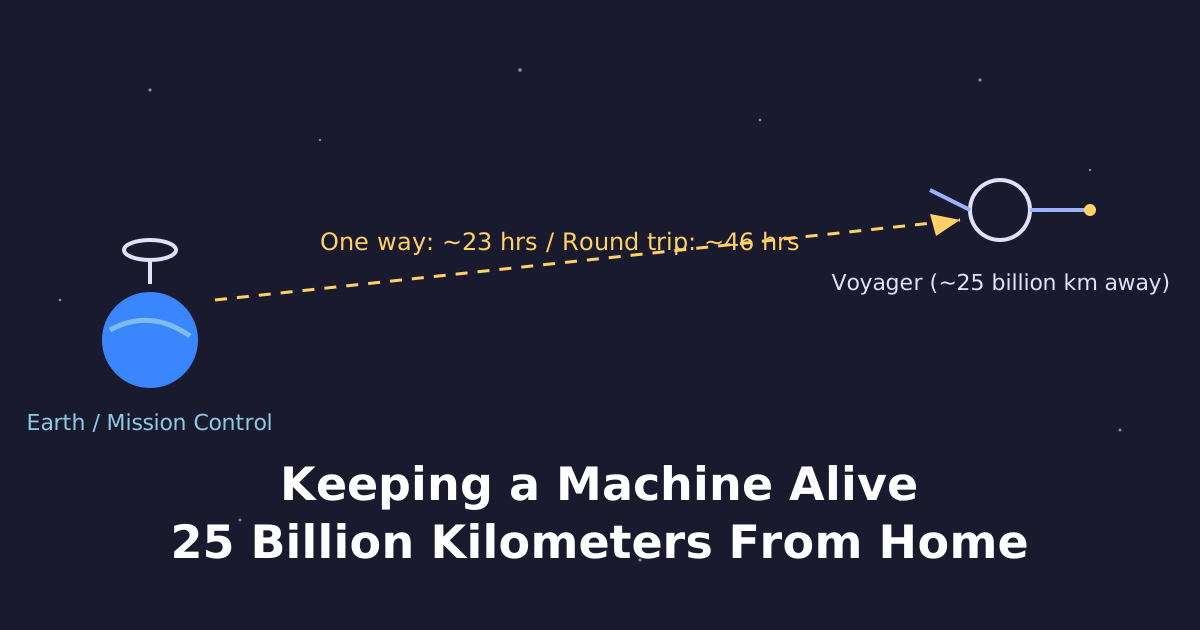
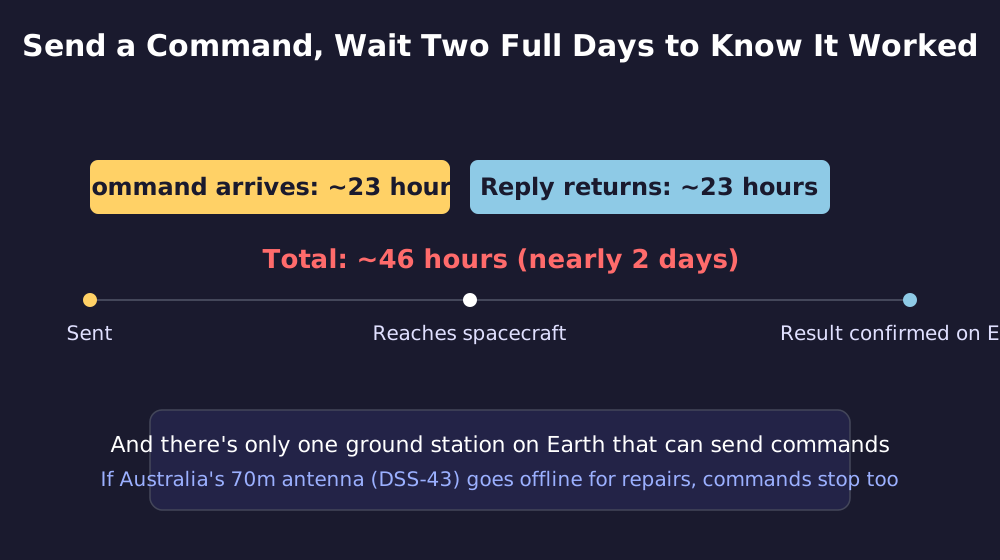
Voyager 1 sits roughly 25 billion kilometers from Earth, according to NASA’s 2026 figures. Radio waves travel at the speed of light, and even so, a one-way trip takes about 23 hours.
Send a command, and it reaches the spacecraft roughly 23 hours later. The result comes back to Earth another 23 hours after that. Confirming whether a fix actually worked takes nearly two full days.
Picture yourself in the control room for a second. You send a correction to a machine that’s already half broken. You hit send, and for the better part of a day, you have no idea whether the thing on the other end is alive or dead. Send the wrong command, and by the time it arrives, there’s no taking it back.
To make matters worse, there’s effectively one antenna on Earth capable of sending commands to Voyager at all: a 70-meter dish in Canberra, Australia, known as DSS-43. According to NASA, it’s the only antenna with enough signal strength to reach both Voyager spacecraft. When that antenna goes offline for maintenance, commands simply can’t be sent.
A patient that’s unreachable, slow to respond — two days round trip — and utterly unforgiving of mistakes. That’s the baseline condition behind every attempt to keep Voyager alive.
You Can’t Fix a Dead Chip, So They Moved the Code Instead
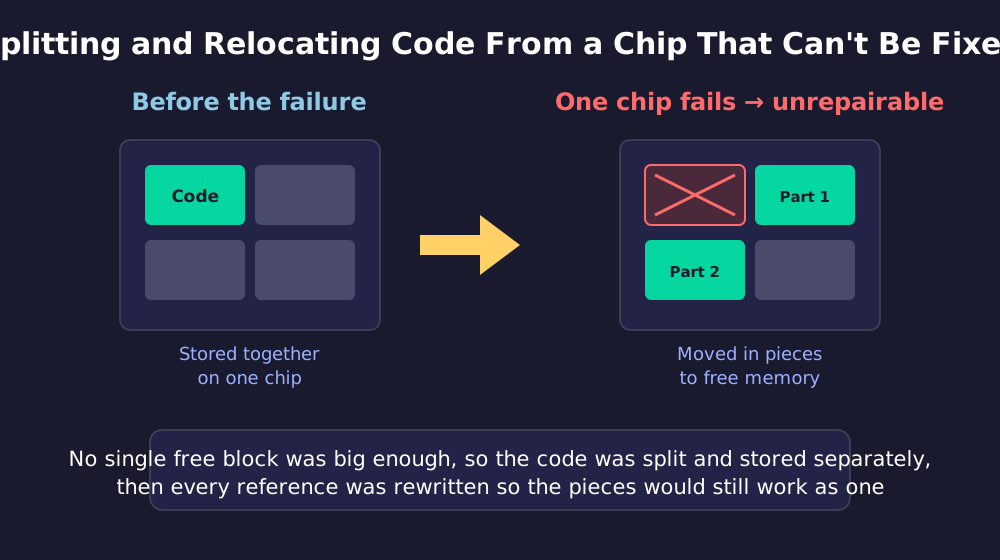
So how did the team actually fix the FDS? You can’t repair a chip, and there’s no spare one waiting in a drawer. Instead, they decided to move the code that had been sitting on the damaged section into some other part of memory.
The catch: there was no single block of free space big enough to hold all of that code at once. So the team split it into pieces, tucked them into scattered free spots, and made sure the fragments would still work together as a whole. Then they went through every other piece of code that called on it and rewrote all the references to point to the code’s new locations.
On April 18, 2024, the team sent a command telling the portion of code that reports spacecraft status to run from its new location. The reply arrived on April 20. The signal had returned to something readable. According to NASA, it was the first time in five months the team could check on the spacecraft’s health.
Decoding decades-old software against design documents written long before most of the team was born, then rewriting it piece by piece over a two-day communication lag — there’s nothing dramatic about that. It’s slow, meticulous, borderline tedious work. Honestly, I think that tedium is the whole point of this story.
Waking an Engine That Had Slept for 21 Years
Software isn’t the only thing that degrades out there. The thrusters that keep the spacecraft properly oriented slowly clog up too.
Voyager 1 has to keep its antenna pointed at Earth, and a set of backup thrusters has handled that rotation continuously since 2004. According to NASA, residue had been building up inside the fuel lines feeding those thrusters, and by fall 2025 there was a real risk they’d clog completely.
Here’s the part that catches you off guard: the team’s fix was the primary set of thrusters — the ones that had failed back in 2004 and had been written off as unusable for more than two decades. Could they bring that one back to life instead?
The primary thrusters had gone dark because two small internal heaters lost power. The team suspected a switch somewhere in the power circuitry had flipped on its own. Flip it back, and the heaters might work again — like reaching into storage after 21 years to pull out a machine everyone had forgotten about, except you’re doing it by remote control across billions of kilometers.
On March 20, 2025, the command went out. Because of the signal delay, the team didn’t see the outcome until nearly a full day later. The heater temperatures spiked within 20 minutes — a clear sign of success. And they’d needed to pull it off before the Canberra antenna went offline for a long maintenance shutdown. It was a photo finish.
Four Watts Lost Every Year, No Negotiation
They fixed the software. They revived the thrusters. But there’s one kind of decline nothing can stop: power.
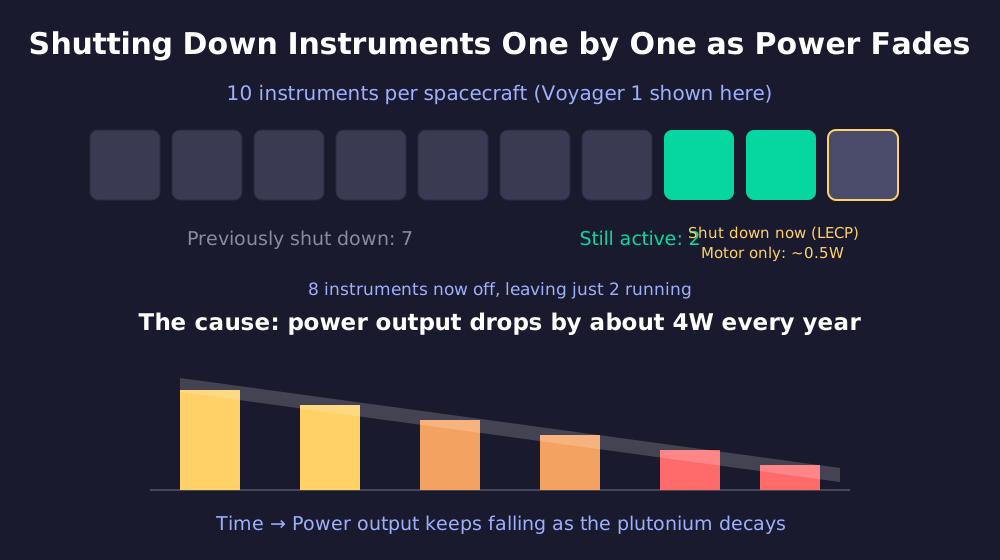
Voyager runs on heat from the natural decay of plutonium. That decay slows a little more every year, and according to NASA, both spacecraft lose roughly 4 watts of generating capacity annually. Four watts is less than a phone charger draws. And it simply vanishes, with zero room to negotiate.
So the team has shut down one science instrument after another as the power keeps falling. On April 17, 2026, they sent the command to power down Voyager 1’s Low-Energy Charged Particle instrument (LECP). According to NASA, that brought the tally of disabled instruments to eight out of ten on each spacecraft. The only two still gathering science data on Voyager 1 today are the plasma wave and magnetic field instruments.
Oddly enough, even a “disabled” instrument keeps drawing some current. LECP still runs the small motor that rotates its sensor, pulling about 0.5 watts. The team tracks electricity down to fractions of a watt and debates, line by line, what else can be cut. Keeping Voyager alive means running a household budget measured in single watts.
In August 2026, the team pulled off something they nicknamed the “Big Bang” on Voyager 2: shutting down several instruments at once, switching others to lower-power modes, and holding the spacecraft just warm enough not to freeze. NASA says the move should keep the remaining three instruments on Voyager 2 running for at least another year.
Living With a Machine You Can Never Touch
Come to think of it, none of this is unique to spacecraft. The decades-old water heater at your parents’ house. A car nobody makes parts for anymore. A laptop whose support ran out years ago. Everyone has kept something irreplaceable limping along a little longer than they probably should have.
Voyager’s survival is just the extreme version of that same instinct. The patient is 25 billion kilometers away. Every command takes two days round trip. You can’t fix a dead chip, so you relocate the code around it. You can’t unclog a thruster, so you wake a backup that’s been asleep for 21 years. You hunt for power to cut, one watt at a time. None of it is glamorous. But stop doing it, even once, and it’s over.
A machine humanity launched half a century ago is still speaking to us, barely, held together by the hands-on work of engineers on the ground. We dug into the power problem itself in this piece.
Tonight, as every night, the 70-meter dish in Canberra is pointed toward the southern sky. A command leaves it, crosses 23 hours of darkness, and quietly reaches humanity’s most distant machine. Whether it’s still alive — we’ll find out two days from now.


