A lot of people picture black holes as something permanent — cosmic drains that never run dry. But run the physics, and a different picture emerges: black holes slowly leak light, lose mass, and eventually vanish altogether. Stranger still, the smaller ones run hotter and disappear faster.
NASA’s own explainer notes that small black holes formed in the early universe “may have evaporated” as the cosmos aged. Even an object that reads as a symbol of eternity comes with an expiration date built in. This is a story about how that ending plays out.
A “one-way hole” that leaks a little light
By definition, a black hole is a region where not even light can escape. The boundary is called the event horizon — cross it, and there’s no getting back out. Taken at face value, that sounds like a one-way street: everything goes in, nothing comes out.
Then, in 1974, physicist Stephen Hawking showed theoretically that the opposite was also true. Just outside the event horizon, a faint trickle of radiation leaks away. Today we call it Hawking radiation.
The key idea comes from quantum theory: empty space isn’t actually empty. Even a vacuum fizzes with pairs of particles and antiparticles that pop into existence and vanish again almost instantly. When that fizzing happens right at the edge of the event horizon, one particle can fall in while its partner escapes outward.
From the outside, it looks as though the black hole just emitted light. And for every bit of energy that escapes, the black hole loses a sliver of mass. So a black hole isn’t purely a one-way sink — it’s also leaking, ever so slightly.
That said, this radiation is so faint that nobody has directly detected it yet. Worth saying plainly: everything here rests on theory and calculation, not observation.
The more mass you add, the colder it gets
Hawking radiation comes with a temperature. Like a stove that glows brighter the hotter it gets, a black hole radiates more fiercely the higher its temperature. The catch is in how that temperature gets set.
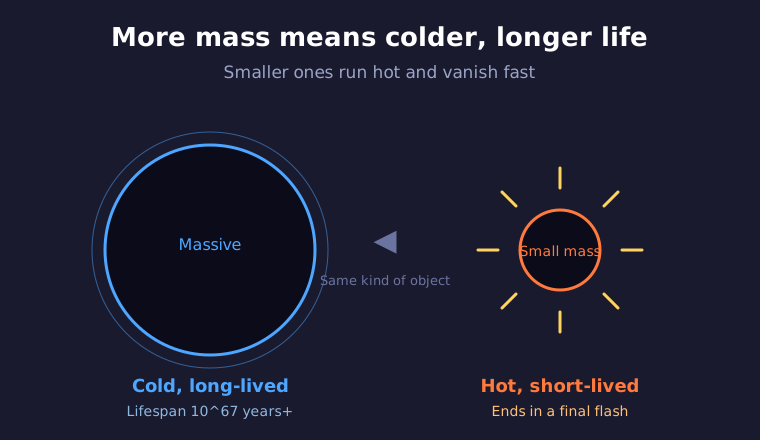
Honestly, this detail scrambled my brain a little the first time I ran into it: a black hole’s temperature is inversely proportional to its mass. Heavier black holes run colder. Lighter ones run hotter.
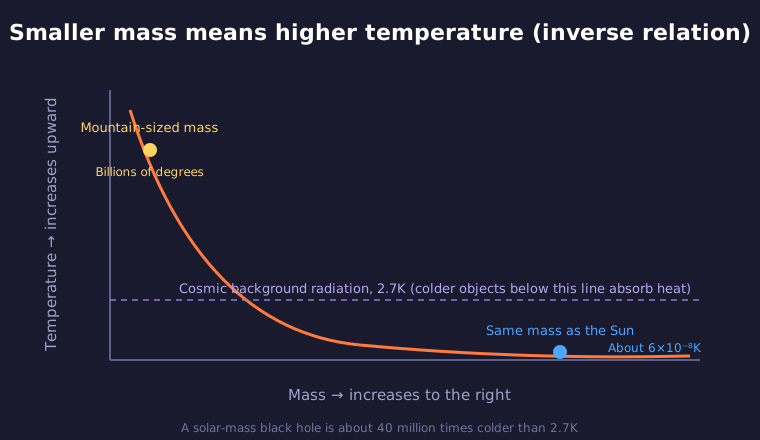
How cold are we talking? A black hole with the same mass as the Sun comes out to roughly 6×10⁻⁸ kelvin — six-hundred-millionths of a degree above absolute zero. For comparison, your kitchen freezer sits at about -18°C, or 255 kelvin. That’s not even close to the same order of magnitude.
Pause on that for a second. Empty space itself is bathed in leftover radiation from the Big Bang, holding steady at about 2.7 kelvin. A sun-mass black hole is roughly 40 million times colder than that background glow.
That chill matters more than it sounds. Because the surrounding universe (2.7K) is actually warmer, black holes like this aren’t shrinking right now — they’re very slightly gaining mass by absorbing ambient heat. Evaporation won’t win out until the universe itself cools well below a black hole’s own temperature, which is a long way off.
Think of it like a refrigerator that gets colder the more food you pack into it. That backwards logic is the thread that runs through everything else in this story.
Timescales that break your sense of scale
So once the universe does cool down enough, how long does it actually take for a black hole to evaporate completely? Since temperature runs inversely with mass, heavier black holes radiate more weakly and take correspondingly longer to disappear.
According to the calculations, a black hole with the Sun’s mass would take roughly 10^67 years to evaporate fully. That number probably doesn’t register as anything in particular — it didn’t for me either, until I counted the zeros myself.
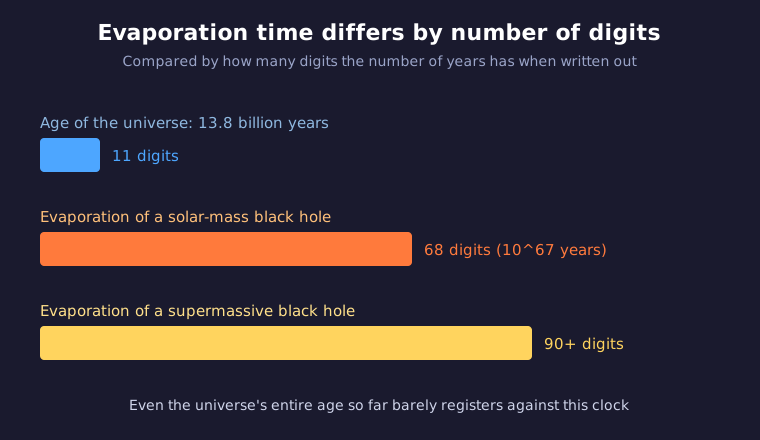
Let’s translate that. The universe’s age so far, 13.8 billion years, written out as a number is “13,800,000,000” — just 11 digits. Ten to the 67th power, on the other hand, is a 1 followed by 67 zeros: 68 digits in total.
Put differently, the entire span of time the universe has existed so far amounts to essentially zero progress toward a sun-mass black hole evaporating. Whatever “eventually” means in “it eventually disappears,” it’s parked somewhere almost incomprehensibly far in the future.
Try to bring it closer to home: even if you compressed the universe’s entire age into a single second, 68 digits’ worth of years would still stretch out far beyond that compressed instant. Reach for the longest “forever” you can think of in everyday life, and it still isn’t close to long enough.
Go bigger still. Supermassive black holes — millions to billions of times the Sun’s mass — take more than 10^90 years to evaporate: a number with over 90 zeros. Mass matters disproportionately here; triple the mass, and evaporation time multiplies by 3³, or 27. The bigger they are, the more absurdly long they stick around.
Somewhere out there, a small black hole might be vanishing right now
So far, this has been a story about big and long-lived. But where are the small, fast-fading black holes we were promised? The leading candidates are primordial black holes — objects thought to have formed in the universe’s earliest moments.
According to NASA, primordial black holes may have formed within the first second after the universe began, and the range of masses they could have is enormous — anywhere from a hundred-thousandth the mass of a paperclip to 100,000 times the mass of the Sun. Compare that to ordinary black holes born from dying stars, which start at roughly three solar masses and up; primordial black holes reach into a far lighter regime entirely.
Here’s where it gets interesting. NASA states plainly that lower-mass black holes evaporate faster. A primordial black hole lighter than a mountain could, in principle, have already finished evaporating sometime during the universe’s 13.8-billion-year history. And by some calculations, one with roughly a mountain’s worth of mass could be reaching the end of its life right about now.
Evaporation accelerates as it proceeds. Shrink a little, and the temperature climbs; climb in temperature, and radiation intensifies; intensify the radiation, and the black hole shrinks faster still. The theory holds that this runaway process ends in a final burst — a flash of gamma rays that dumps the last of the black hole’s energy all at once. Not a quiet fade-out, but a finale with an actual bang.
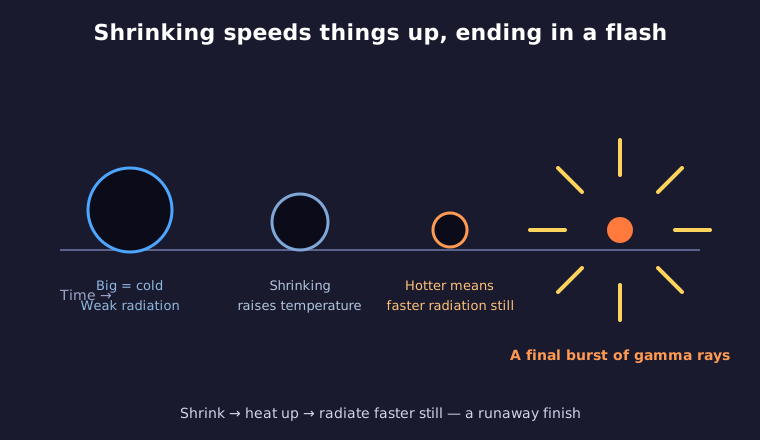
If you somehow caught that final instant, here’s what you’d see: after an unimaginably long silence, a small flicker of light blinking on somewhere in the depths of space. It might look like nothing more than a faint, unremarkable flash. But it would be the last word from an object that had been sitting there since the universe’s infancy.
In the far future, the biggest ones outlast everything else
It’s worth circling back to the paradox at the heart of all this. Big black holes run cold and live long; small ones run hot and die young. Everyday intuition says the opposite — a bonfire burns for hours, a match goes out in seconds. Black holes flip that logic entirely: bigger means colder, full stop.
That flip ends up shaping the far future of the universe. Eventually, stars will burn out, galaxies will go dark, and no new stars will be born to replace them. In that long dark age, the objects expected to persist the longest — the very last things still recognizably “there” — are the coldest, longest-lived of all: the supermassive black holes.
And when even the largest of those finally finishes evaporating, after a span of time approaching 10^100 years, the last organized structure in the universe will be gone. What remains is a thin mist of radiation, spreading out and thinning further, forever.
Every star you look up at tonight will eventually go dark. But long, long after that light fades — in a universe gone almost entirely black — some surviving sliver of a black hole will flare once, briefly, and then wink out for good. The physics already has that scene written into it.