On the surface of the Sun, 150 million kilometers away, we can now pick out individual features as wide as Tokyo is from Yokohama. The instrument that captured this sits atop a mountain in Hawaii — the largest solar telescope on the ground. Not a space telescope. Ground-based, full stop.
Its name is the Daniel K. Inouye Solar Telescope, operated by the U.S. National Solar Observatory (NSO).
Not a smooth, glowing ball after all
In 2020, the telescope released its first images. What they showed was a surface packed edge to edge with a texture of grains.
According to the NSO, hot plasma — electrically charged gas — wells up at the center of each bright grain, cools, and sinks back down along the dark lanes between them. It’s essentially the same convection you’d see on the surface of a bowl of miso soup, just happening at a wildly different scale.
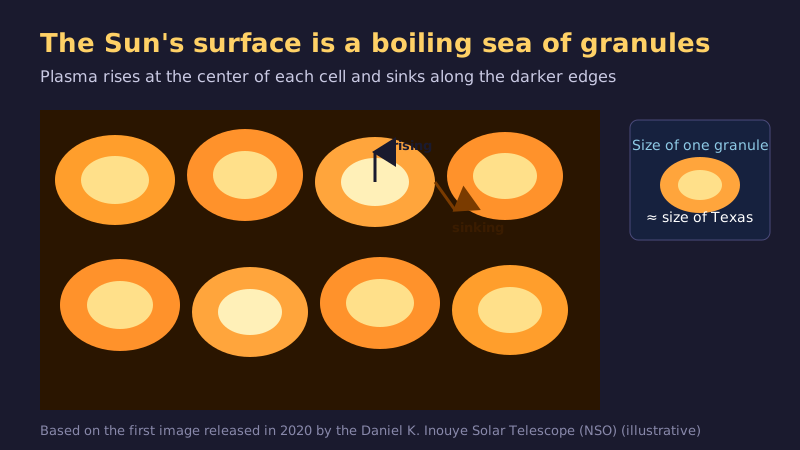
Each individual grain, the NSO says, is roughly the size of the entire state of Texas. For scale, that’s about the size of Japan’s main island, Honshu. And each one of those grains rises and collapses in a matter of minutes.
I assumed that number was a typo the first time I read it.
And this isn’t a still photo. The NSO says the telescope can capture structure three times finer than anything seen before — multiple times per second. That means the whole life cycle of a grain, from birth to swelling to collapse into the dark lanes, can be recorded as actual moving footage.
The Sun looked like a “quiet glowing ball” for so long simply because nobody could see it closely enough. So how close can we get now?
The strange feat of resolving 30 kilometers
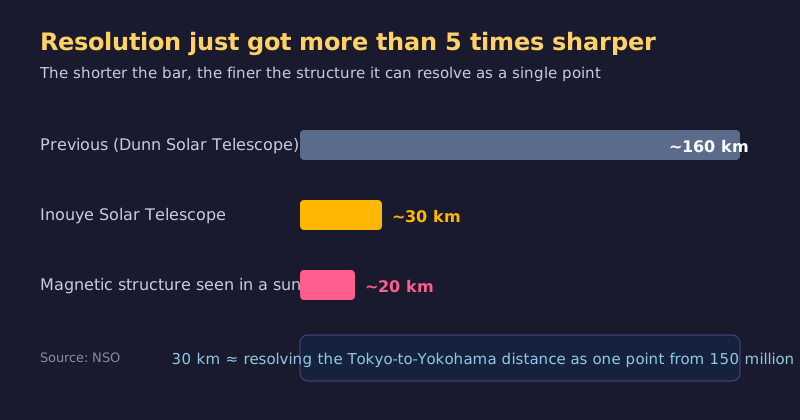
According to NSO, the smallest structure this telescope can resolve is about 30 km. The Sun’s diameter is more than 100 times Earth’s, so at that scale, 30 km is little more than the width of a needle’s tip.
The natural comparison is the Dunn Solar Telescope, which NSO has operated for decades. Its resolution tops out around 160 km. The new telescope, in other words, is more than five times sharper.
Picking out 30 km on an object 150 million km away is, on Earth’s scale, like resolving the distance between Tokyo and Yokohama as a single thin line, viewed from an unimaginable distance.
The Sun is our nearest star, but it’s still absurdly far away. Resolving 30 km at that distance says something about how blurry our picture of the Sun really was until now. For decades, astronomers had to infer the Sun’s finer details rather than actually see them.
The real question is why a ground-based instrument can pull this off at all. Atmospheric turbulence makes stars twinkle and blurs a telescope’s view — it should be the enemy here. Sending a telescope to space seems like the obvious advantage.
Canceling atmospheric blur, every single second
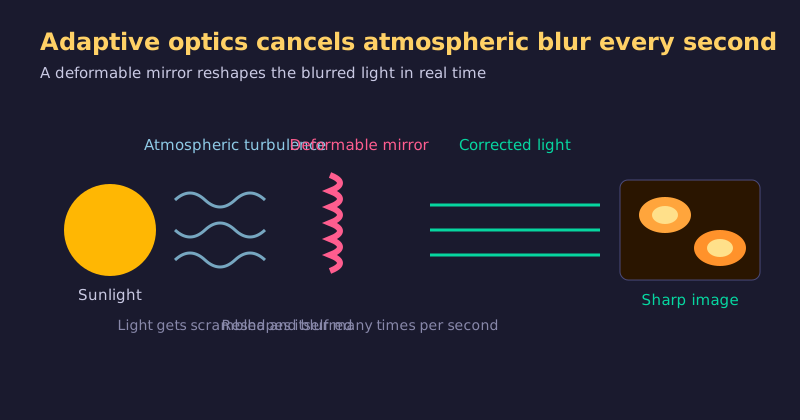
Two things make it work: a big mirror, and a technology called adaptive optics. Location matters too. The telescope sits atop Haleakalā, a roughly 3,000-meter volcano on Maui, Hawaii. Thin, clear high-altitude air already cuts down on the atmospheric turbulence that plagues ground-based astronomy.
Start with the mirror. At 4 meters across, the primary mirror is the largest ever built for a solar telescope, according to NSO. A bigger mirror can, in principle, resolve finer detail. But a big mirror alone means nothing if the atmosphere blurs everything it collects.
That’s where adaptive optics comes in. It’s a system that reshapes light distorted by the atmosphere using a mirror that can change its own form in real time — and it does this many times a second. Think of it as a machine that anticipates a star’s twinkle and cancels it out before it happens.
Solar adaptive optics also faces a challenge nighttime astronomy doesn’t. At night, you can lock onto a single star as a reference point to measure atmospheric distortion. The Sun offers no such single point — its whole face is a sprawling, textured surface. Engineers had to find a way to read atmospheric turbulence using the surface pattern itself as the reference.
I’ll admit I long assumed space telescopes were categorically superior to ground-based ones for this kind of work. But ground-based instruments have their own advantage: it’s much easier to build a mirror with a large aperture. The atmosphere is a real obstacle, but once you out-engineer it, ground telescopes can absolutely compete.
One more detail: focus 4 meters’ worth of sunlight into one point, and the heat becomes ferocious. A dedicated cooling system runs continuously just to keep the mirrors and instruments from melting. What this telescope collects isn’t just light — it’s an enormous amount of heat, too. Picture the childhood trick of burning paper with a magnifying glass, scaled up to something genuinely dangerous.
What researchers actually want isn’t light — it’s the magnetic field
A beautiful image is only half the story. What researchers are really after is the Sun’s magnetic field.
Sunspots and solar eruptions are both driven by disturbances in the magnetic field. The trouble is, the field itself is invisible. So scientists turn to polarization — the orientation bias of light’s oscillation — and measure it precisely to reconstruct what the magnetic field underneath looks like.
In images released in 2020, the telescope resolved magnetic structures as fine as 20 km within a sunspot. NSO notes that the sunspot in question was large enough to swallow the entire Earth. A single “blemish” on the Sun can be big enough to engulf a planet.
Sunspots look dark, but they’re still hotter than 4,000°C. They appear dark only because they’re somewhat cooler than the surrounding surface — “cooler” here still means hotter than any flame on Earth.
NSO states that this is the first time anyone has been able to continuously measure the magnetic field of the Sun’s corona, its thin outer atmosphere. In other words, researchers have started tracking an invisible field at a level of detail nobody has had before.
Here’s where it gets interesting. That invisible magnetic turbulence eventually reaches all the way down to our daily lives here on Earth.
When the Sun’s magnetic field twists, GPS and power grids feel it
When the Sun’s tangled magnetic field snaps loose, it triggers flares — explosions on the solar surface — and releases huge bursts of charged particles. When those reach Earth, we get what’s known as space weather.
And when space weather turns rough, satellites can malfunction, GPS coordinates can drift off, and in severe cases, power grids can be overloaded to the point of blackout. That “current location” your phone showed you this morning traces back, in some small way, to the Sun’s mood.
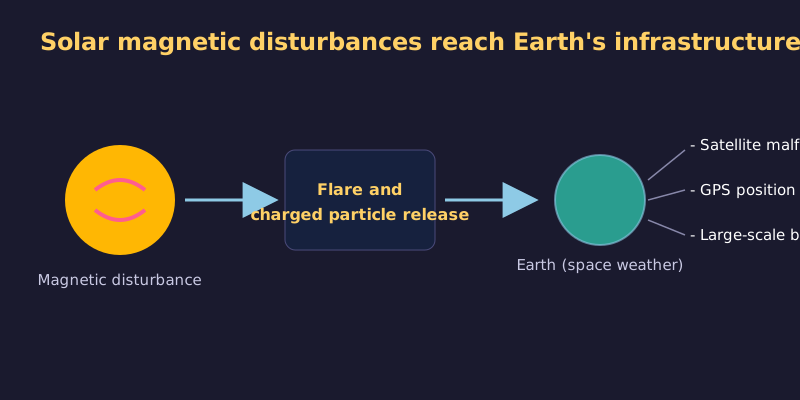
History has a few documented cases of major magnetic storms disrupting communication and power networks. The Sun may be a distant celestial object, but it’s directly wired into the infrastructure of daily life. That’s exactly why scientists want to understand, down to the finest detail, how a magnetic disturbance grows into an eruption.
Resolving the Sun’s magnetic field at this level of detail is a bit like sharpening a weather forecast. Where and when will a magnetic disturbance build into an eruption? Researchers say being able to watch that process unfold at a resolution nobody has had before is a genuinely big deal.
For what it’s worth, NSO says the telescope produces about 9 terabytes of data a day during normal operations. That’s how much information it takes to record the Sun’s “face of the day,” every single day. Space weather forecasting is, in essence, an attempt to read the next storm from the accumulated record of how that face keeps changing.
The Sun is still a stranger next door
The Sun is Earth’s nearest star, and it’s still about 150 million km away. Close enough — and far enough — to be the one star whose churning surface we can actually watch as moving footage. Every other star scattered across the night sky is probably boiling in the same way, if you could just get close enough to see it. The Sun just happens to be the first one we’ve gotten that close to, and it rises over our heads every morning without fail.
Here’s a detail worth pausing on. The Texas-sized sea of granules in that image is what the Sun looked like eight minutes ago. Light takes eight minutes to reach us, so what you’re seeing was never “now.”
If you could somehow stand on top of one of those granules, the floor beneath your feet — roughly the size of Honshu — would surge up and collapse into the dark lanes at its edges within minutes. A white-hot plain, roaring as it boils, stretching all the way to the horizon.
That light you take for granted every morning, filtering in through your curtains — it traveled eight minutes from a place like that to reach your room.