I always came in last in the far-seeing contest.
In our town, seeing far is the highest honor there is. Every autumn, everyone polishes their gold-rimmed spyglasses until they shine, then scans the night sky for the faintest, farthest light they can find. Come in last, though, and Grandma docks you one dumpling from your plate. That part stung more than anything.
My eyes are useless at distance. Whenever I try to hunt down a faint light, everything blurs like water. Three years running, I finished last.
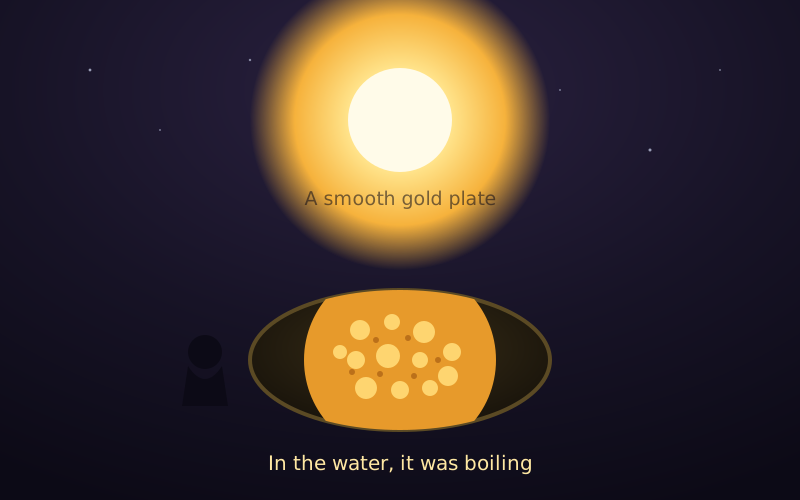
The town has another rule: never look at the face of the sunbright. That’s what we call the thing blazing directly overhead all day. Look straight at it, they say, and you’ll go blind. Nobody actually knows if that’s true. But every sign and every map in town draws it the same way — a smooth gold plate. And nobody ever corrects that picture. How could they? Nobody’s ever seen the real thing.
That afternoon I was sulking by the well, staring at the water. I’d had enough of practicing far-sight for one day.
The sunbright was reflected in the washbasin.
Without thinking, I leaned in for a look. Through water, it didn’t glare. So I saw it.
It wasn’t a gold plate at all.
The sunbright’s face was grainy — packed edge to edge with tiny bright kernels, and none of them held still. It roiled and bubbled, boiling like something about to spill over a giant pot. One grain would surface, then vanish, replaced by another. I forgot to blink.
“Oh, the sunbright,”
said Gen, the well-cleaner, peering over my shoulder with a bucket on his back. “Boils like that all the time. I see it every day.”
Gen’s whole job is looking down. The reflection was so close, so ordinary to him, it never seemed worth mentioning. While the town’s most respected men trained their eyes on the farthest things in the sky, Gen had spent his whole life looking at the nearest one.
I ran home.
For the autumn far-seeing contest, I submitted a drawing. Not one of the night’s distant lights — the boiling, bubbling face from that afternoon.
Old Tetsu, the contest master, took one look and snorted. Tetsu had spent sixty years perfecting far-sight — the most respected man in town.
“What’s this supposed to be? This is a far-seeing contest. Everybody already knows what the sunbright looks like. A smooth gold plate, plain as day.”
“It’s not like that,” I said. “It’s boiling. All grainy. …You can see it, if you look through water.”
Nobody took me seriously. Why would they? I was the kid who always came in last.
But Tetsu went quiet. Then he shuffled over to the well, crouched by the washbasin, and stared into the water. He didn’t move for a long time.
The next morning, every doorstep in town had a bucket of water lined up outside. Nobody was looking at the sky anymore — they were all bent over, staring at their own feet. Crouched lowest of all, right at the front, was Tetsu, the far-seeing master. Sixty years of eyes trained on the horizon, and for the first time, he leaned them in, slow and careful, toward the boiling gold right above his head.