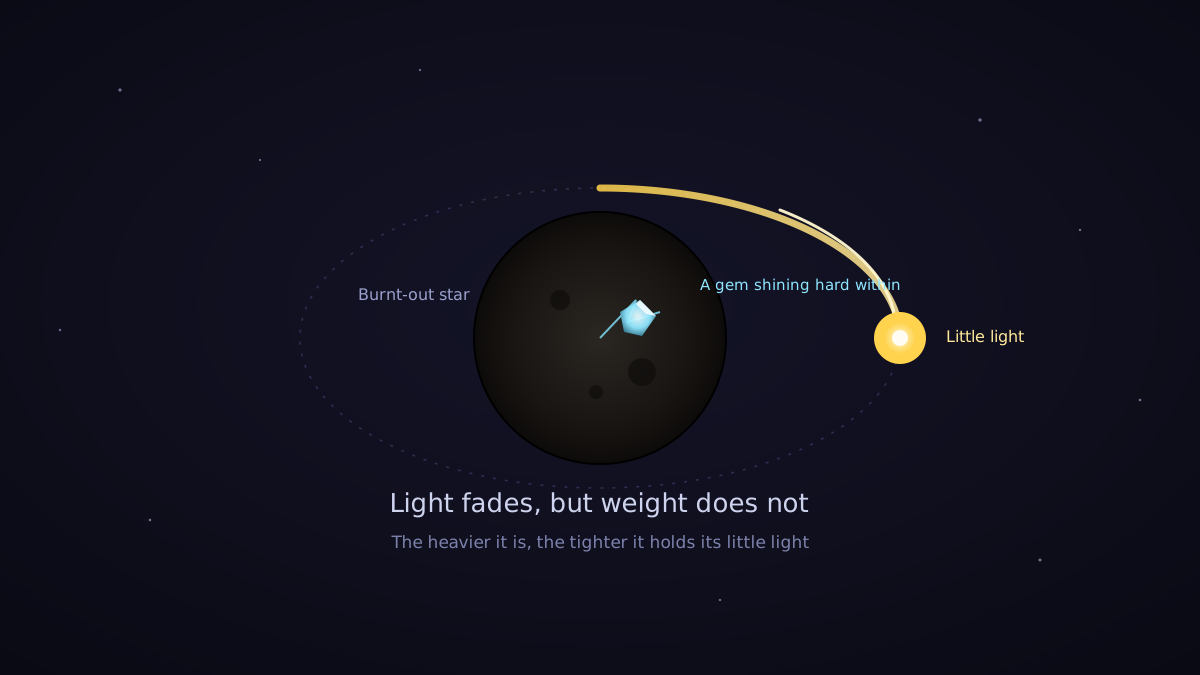
All Old Kasa wanted was one more quiet year beside this star, eating his potatoes in peace. The black star had burned out long ago—nothing left of it but a cinder. A single small light circled it, spinning too fast for the eye to follow, and had done so, without rest, for decades.
“Hey, Old Kasa. Why does that little bean-star spin so fast?”
Beside him, Mame pointed up at the dark sky.
“The heavier something is, the tighter it holds on to what’s nearby.”
Old Kasa bit into a cold potato and played dumb. His lunch, incidentally, was always a cold potato. Whether he actually enjoyed it, even he didn’t seem entirely sure.
For fifty years, Old Kasa had graded burnt-out stars. Stars that still shone got stamped “First Class.” Stars that had gone completely dark got stamped “Ash.” Once a star wore the ash stamp, it was written off as worthless and shoved to the back of the extraction line. In this town, if something didn’t shine, it might as well not exist.
In the ledger, the black star’s row was crammed with fifty years of Kasa’s “Ash” stamps—hundreds of the same mark, each one a little fainter than the last. Nobody ever bothered to look inside.
Truth was, that black star was the heaviest thing in town. Light fades, but weight doesn’t. Because it was so heavy, it refused to let go of its small light. Lighten it even a little, and that light would snap free like a cut string and vanish into the dark. Old Kasa was the only one who knew.
There was something else, too. Over the long years, crushed under its own weight, the star’s ash had hardened deep inside into cold, sharp, glittering stone—a jewel nobody had ever come to dig for.
One day, the extraction crew got a new boss: a young man named Toga. He flipped through ledgers fast, talked faster, and had a knack for spotting waste.
“Old Kasa. Fifty straight years of ‘Ash’ on this black star… did you actually check the inside?”
“I checked. Ash is ash.”
“No way—you’ve never once cracked this thing open in fifty years. That’s suspicious. Old man, are you hiding something? Like, I don’t know, treasure?”
Toga grinned. That same day, he brought in a crew and had them crack the black star’s crust open in one spot.
A fragment flashed.
Cold, sharp, blinding. Everyone caught their breath. This wasn’t ash. It was gemstone.
“I knew it! Old man, you—”
Toga’s voice cracked with excitement. His mind was probably already racing through plans to haul out every last stone. The crew started peeling away the star’s crust, piece by piece. Little by little, the star grew lighter.
That was when it happened.
“Ah… the bean-star—”
Mame pointed at the sky and let out a small cry.
The little light, spinning fast a moment ago, began to slow. Its orbit swelled outward. As the star lost weight, the pull holding the light in place had loosened. The light drifted farther and farther out, its circle widening. One more scrape, and the string would snap. It would never come back.
Toga’s hands went still.
He wanted the stone. But taking it meant hauling out every last bit of that weight. And once the weight was gone, the light that had circled so faithfully for fifty years would vanish alone into the dark.
Nobody wanted to be the man who cut that light loose.
Toga stood there a while, staring up at the black star. Then, without a word, he picked up Old Kasa’s ledger. Beside the star’s row—hundreds of stamps deep—he wrote, in his own hand:
“Ash. Worthless.”
”…Put it back. Every last fragment. Fit it all back in.”
Grudgingly, the crew returned everything they’d carved away. The black star settled back into its old, solid weight.
Around the dark star, the small light resumed its faithful orbit, once again spinning at its old, dizzying speed.