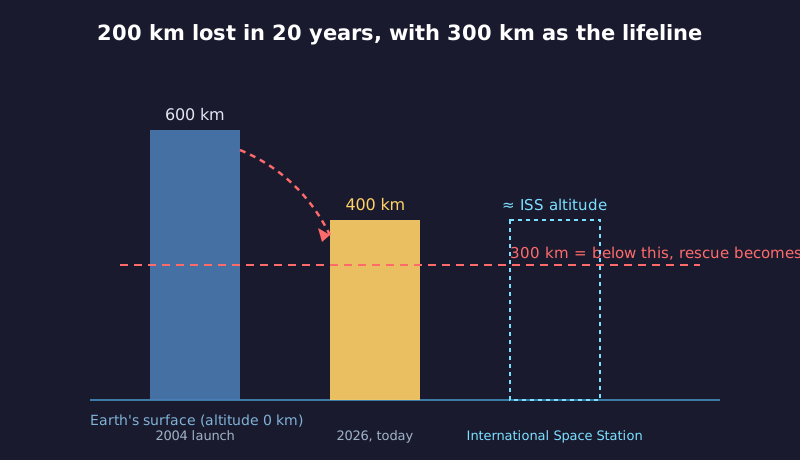
Right now, a space telescope orbiting Earth is slowly falling. NASA’s Swift Observatory started out at 600 kilometers back in 2004. Somewhere along the way, without much fanfare, its altitude slipped to 400 kilometers.
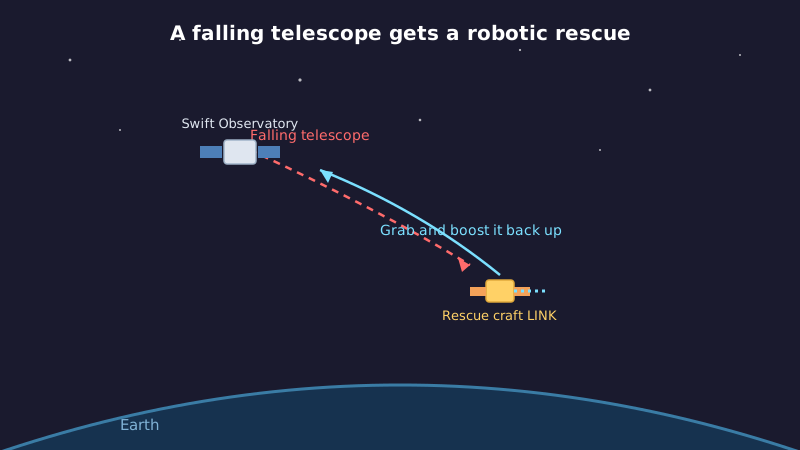
Left alone, it was expected to plunge into the atmosphere and burn up by late 2026. But before that could happen, someone tried something that had never been done before: sending another robotic satellite to grab the falling telescope and push it back up.
A 20-Year Veteran Has Sunk to the Height of the ISS
Swift is built to catch the flash of the most violent explosions in the universe. It watches for gamma-ray bursts — brief, ferociously bright bursts of light that flare up when, among other things, a distant star dies — and swings its instruments toward them within seconds. It’s been doing that job for more than 20 years since 2004, and it’s very good at it.
But somewhere in that time, its orbit started to shrink. It launched at 600 kilometers. Today it’s down to roughly 400 kilometers.
That number might not mean much on its own, so here’s a comparison: the International Space Station flies at almost exactly that altitude. Swift has drifted down to where astronauts actually live.
So why does anything in space fall at all? Isn’t it supposed to be a vacuum up there? What’s dragging this telescope down?
Space Isn’t Quite Empty
Altitudes of 400 to 600 kilometers are unambiguously “space” — the sky is pitch black, and the air is hundreds of millions of times thinner than at ground level. But thinner isn’t the same as nothing. A trace of atmospheric molecules still lingers even that high up.
Swift barrels through that faint haze at roughly 7 to 8 kilometers per second — fast enough to cross the distance from Tokyo to Osaka in under a minute. At that speed, even a near-vacuum adds up. Every molecule it plows through chips away a tiny bit of momentum.
Think of pedaling a bicycle as hard as you can into a headwind. You can’t see the air, but it pushes back all the same. What Swift is fighting is a far, far thinner cousin of that wind. Drag steadily bleeds off the satellite’s orbital energy, and as the energy goes, so does the altitude.
This isn’t unique to Swift, either. Every satellite in low orbit is, to some degree, destined to fall eventually. The clock starts ticking the moment it launches.
So why did Swift’s descent suddenly speed up in the last few years? The culprit turned out to be somewhere unexpected.
The Sun Puffed Up Earth’s Atmosphere
Around 2024, the Sun was approaching the peak of its activity cycle — more eruptions on its surface, and more turbulent space weather reaching Earth.
When the Sun gets active, Earth’s upper atmosphere absorbs extra heat and expands outward. Air that would normally stay lower now puffs up to higher altitudes and gets denser there. For a satellite flying at a fixed altitude, that’s the equivalent of the headwind suddenly picking up. More drag means a faster fall.
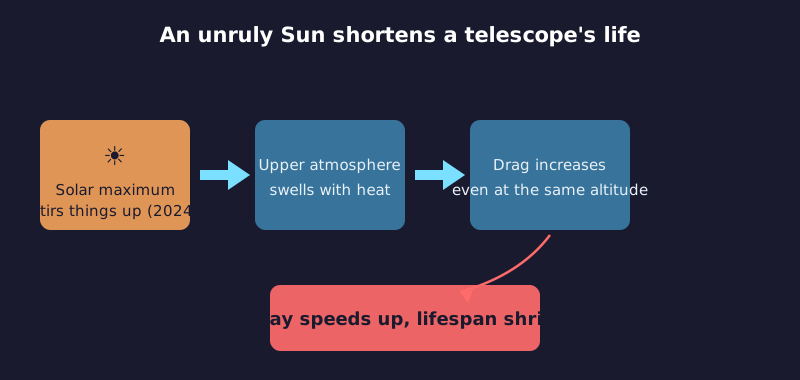
There’s something almost unfair about a telescope’s lifespan hinging on the Sun’s mood. An eruption happening unimaginably far away ends up quietly eating into the remaining years of one particular instrument back at Earth.
And there’s a hard line Swift couldn’t afford to cross: 300 kilometers. Drop below that, and the kind of rescue described below becomes essentially impossible. Left unchecked, the observatory was projected to make an uncontrolled reentry by the end of 2026.
Imagine standing right next to Swift at 400 kilometers. You wouldn’t see anything dramatic — just an invisible wall of air, thickening bit by bit, tugging the telescope closer to Earth. No sudden drama. Just an ending that keeps quietly closing in.
The “Tow Truck” Idea: Grab It and Push
Historically, once a satellite starts falling, there isn’t much anyone can do. It can burn its own fuel to maintain orbit, but once that runs out, that’s usually the end of the story. Most satellites have met their fate exactly that way.
This time, NASA chose a different path. In September 2025, it hired Katalyst Space, a company based in Flagstaff, Arizona, to attempt a rescue. Katalyst designed, built, and tested a robotic servicer called LINK in under a year and launched it.
The launch happened on July 3, 2026, over the Kwajalein Atoll in the Marshall Islands — and not via a conventional rocket blasting straight up from the ground. A modified L-1011 aircraft named Stargazer carried a Pegasus XL rocket, with LINK tucked inside, up to about 12 kilometers. The rocket separated there and ignited midair. It’s known as an air launch: firing a rocket from an airplane rather than a launch pad.
Meanwhile, Swift’s own operations team had already been buying time by tweaking the spacecraft’s orientation to minimize drag, squeezing out a few extra months of altitude. That effort turned out to matter — it was just enough of a cushion for the rescue craft to get ready in time.
Here’s the part that makes this genuinely fun to think about: picture a tow truck pulling up to a car that’s stalled out on the side of the road. That’s essentially what’s happening in orbit. A stranded telescope, and another machine deliberately flying out to meet it.
There’s just one enormous catch. Swift was never built with the idea that anyone would ever grab it.
Grabbing Something That Was Never Meant to Be Grabbed
Swift dates to 2004, an era when the idea of in-orbit servicing barely existed as a concept. The spacecraft has no handles, no docking port, nothing designed to let another machine latch onto it.
LINK has to approach and grip this completely unprepared spacecraft anyway — and then push it back up. Swift, the thing being rescued, is far bigger and heavier than the little robot sent to save it. It’s a small craft nudging a much larger one from behind, patiently, over and over.
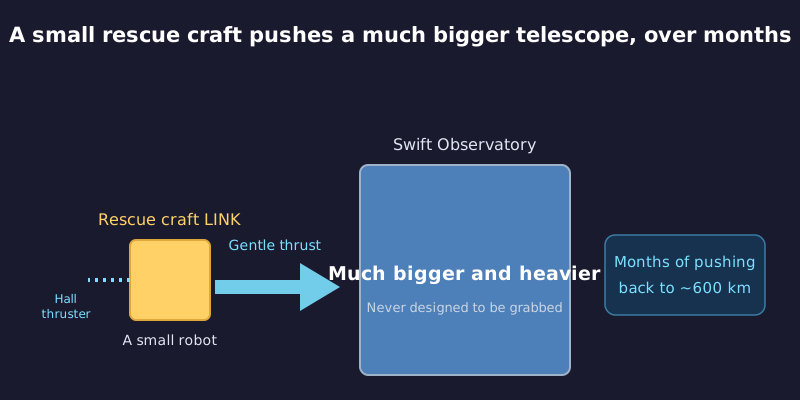
The tool doing the pushing is a Hall thruster, a type of electric propulsion that expels propellant using an electric field. This kind of engine produces very little thrust — nothing like the instant kick of a rocket. What it lacks in power, it makes up for in efficiency: it can keep pushing, steadily, for a very long time.
So LINK isn’t going to hoist Swift back up in one dramatic burst. It’s going to lean into something much bigger than itself with a thrust barely stronger than a breeze, and keep at it for months until Swift climbs back to roughly 600 kilometers. This is not a job for anyone in a hurry.
The procedure itself unfolds slowly, too. After launch, LINK first unfurls its solar panels and checks that its electrical systems are working. Only then does it approach Swift, spending several weeks carefully studying its target before attempting anything. The actual reboost comes after all of that — the whole operation stretches out over months.
I’ll admit, the first time I read about this plan, I wasn’t sure it could really work — it sounded like a tightrope walk. According to NASA, docking a commercial robotic spacecraft with a government satellite that was never designed for servicing would be unprecedented. If it succeeds, it could quietly rewrite the assumption that satellites are simply disposable once their fuel runs out.
Somewhere Out There, a Tow Truck Is Already on Its Way
Every satellite starts falling the moment it launches. In low orbit, that’s simply the rule of the game, and for decades, the accepted ending was to let a spacecraft burn up once its working life was over.
This attempt slips a new option into that old assumption: if something starts to fall, you can just go get it. If the reboost works, Swift could keep watching for cosmic explosions for years to come. Grab it, push it, buy it more time. Call it roadside assistance, orbital edition.
Tonight, at roughly 400 kilometers — barely higher than the ISS — a telescope is still circling Earth, waiting for the next flash of gamma rays. And somewhere above it, quietly, a rescue craft is closing in.