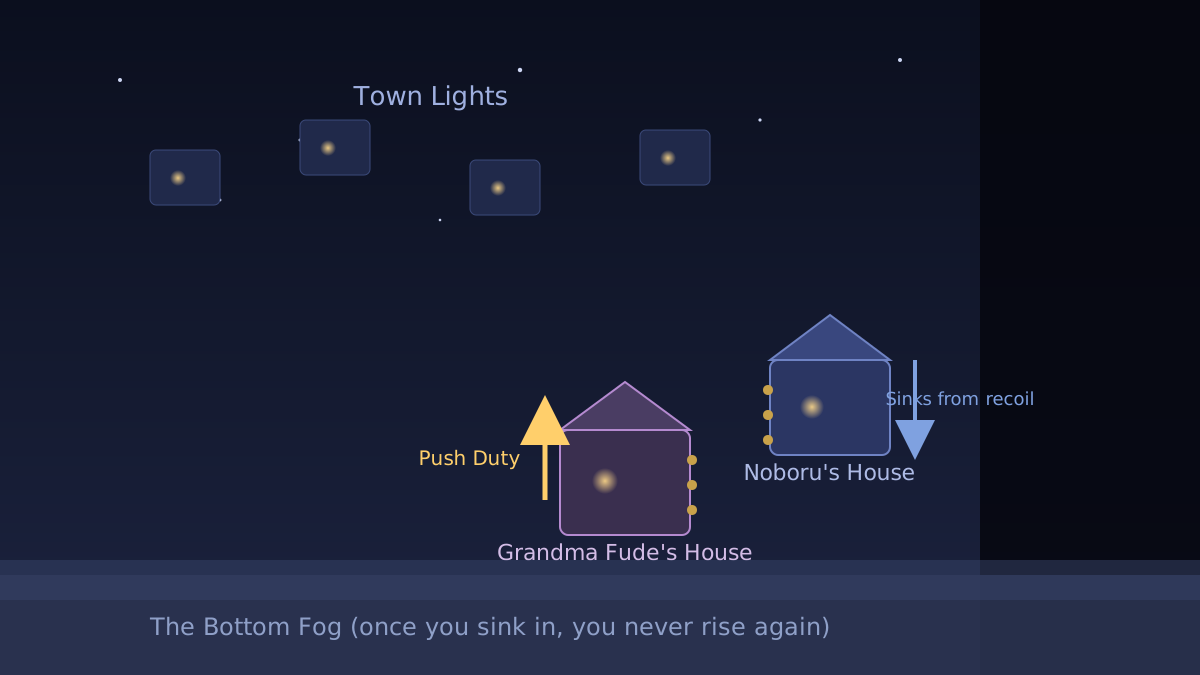
Grandma Fude’s house sits lower than any other in town. And it’s the heaviest, too.
Left alone, the houses in this town sink a little further down each day, drawn toward the Bottom Fog below. Nobody knows what waits down there, because no one who’s gone to look has ever come back to say. So the townspeople take turns pushing each other’s houses up from underneath — an old custom called push duty.
But pushing isn’t free. Push someone else’s house up, and the recoil sends your own house down a little. Lift one person, and you drop by the same amount. That’s simply how it works, apparently.
The one who came to push Grandma Fude’s house every week was a young man named Noboru — a name that, ironically, means “to rise.” This particular Noboru was always the one sinking. Whoever named him clearly wasn’t thinking that far ahead.
Noboru’s house stood right at the edge of town. Beyond the edge, there was nothing — just darkness. So every time push duty came around, Noboru sank a little more. Year after year he dropped lower, until his house and Grandma Fude’s ended up side by side, the two lowest homes in the corner of town.
The townspeople praised him for it.
“What a good boy. Wearing himself down just to help that old woman.”
“Way out there at the edge, and he still looks after her.”
Noboru would just smile vaguely and let it pass.
That day, like every week, he set his hands against the wall of Grandma Fude’s house. Three old handles were bolted there, worn smooth from gripping. Across the way, his own house had the exact same handles — mounted to face hers precisely. It occurred to him, not for the first time, that maybe someone had built these two houses as a matching pair, a long time ago.
“One, two—”
Noboru dug in his heels, and Fude’s house heaved upward. In exchange, his own house dropped with a soft thud.
“Sorry to make you do this every week,” Fude said.
“It’s fine. …Your house got heavier again, didn’t it?”
“It did. I don’t throw anything away, you know. If I got any lighter, I’d float clean off.”
Noboru went quiet for a moment.
Grandma Fude’s house sank by exactly the same amount every single week. Never too much, never too little — as if measured out precisely to guarantee Noboru would have to come back next week, too. Not that anyone in town seemed to think much about that.
Long ago, Noboru’s house had drifted alone at the edge of town, sliding toward the dark. Out there at the edge, there was no neighbor to push it back up. And without someone to hold onto, a house just keeps going — out into the dark, and it doesn’t stop.
That was when Grandma Fude had her own heavy house hauled all the way out to the corner of town. Right beside his.
“There,” she’d told him. “Now you’ve got something to push.”
Ever since, Noboru has been pushing Fude’s house up. Fude has been letting him. The town calls it charity.
On his way out, Noboru glanced under the porch and quietly moved one of the weight stones back into place — a stone Fude had shifted aside earlier. So that next week, her house would sink exactly as much as it was supposed to.
Grandma Fude pretended not to notice, waving slowly as he left. Then she lowered herself onto the sinking floor with a thump.