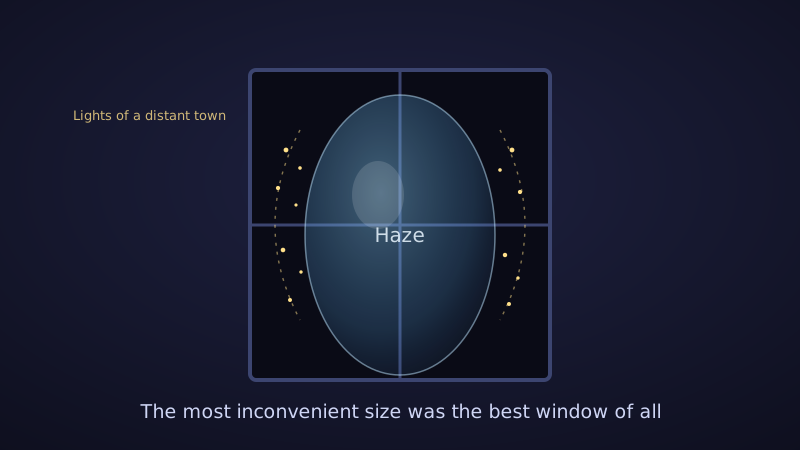
Haze was, well, enormous. The new tenant in unit three was an alien built like a slab of glass filled to the brim with water — translucent all the way through. It liked to settle in front of the landing window and stare out at nothing in particular, hour after hour, not doing much of anything else.
The other tenants weren’t fans. Haze blocked the view, and the view was the one thing this building had going for it: the lights of a distant town, visible from the landing window on clear nights. Nobody knew the town’s name — it belonged to some faraway planet, a port city whose lights flickered on after dark, beautiful in a way nothing else in the building was. At least, until Haze moved in.
“If that thing would just get out of the way, we’d see everything,” said Umeda, head of the tenants’ association, every chance she got. She was short, loud, and glared up at Haze every time they crossed paths in the hallway — not that anyone could actually tell where Haze’s face was supposed to be.
Only Kenchan, from unit two, liked having Haze around. One afternoon he held a spoon up in front of Haze’s body and burst out laughing.
“Look, it’s all bendy!”
He had a point. Anything on the far side of Haze looked warped somehow, soft and curved, like it had melted a little. Kenchan’s finger, the spoon, the window frame — all of it. “Don’t be silly,” Umeda said, dragging him away. “It’s rude to point.”
Eventually a petition made the rounds. Something called the Committee to Protect the Landing View — a name far too grand for what it actually did — collected signatures from nearly every unit. Haze never complained. The night Umeda showed up with the petition in hand, Haze just trembled, faintly. Probably a nod.
“Sorry — for the trouble.”
Haze’s voice sounded like rain falling somewhere far away. That was all it said. By morning, unit three was empty. The landing suddenly felt roomy. Umeda wiped down the window, pleased with herself.
Now, finally, they’d get an unobstructed view of the port town’s lights. The tenants waited for nightfall, practically buzzing.
But that night, the window showed nothing but black. Not a single light. The next night was the same. And the night after that.
“Must be cloudy,” Umeda said. Except — now that she thought about it — the window had gone just as dark once before, the last time Haze had stepped out for a few days. Everyone had blamed the clouds that time too.
Kenchan traced a finger along the window frame.
“Maybe those lights… were coming through where Haze used to sit?”
The adults went quiet for a while. That town was too far away to see in a straight line — everyone knew that, somewhere in the back of their mind. The light had been curving around the edge of Haze’s enormous body all along, bending its way to this window. Haze hadn’t been blocking the view. Haze had been carrying it — bending that distant light and delivering it here. What they’d thought was a window had only ever been a dark wall. The real window had been Haze all along.
That same night, Umeda dug out the building ledger and started tracking down where Haze had gone.
These days, a big, translucent shape sits on the landing again — three days of searching, and Umeda brought it back herself. The petition from the “Protect the View” committee has gone missing, torn up by persons unknown. In its place hangs a new notice: “Unit 3, Dear Haze: Please Stay Forever.” Every evening, Umeda fluffs up Haze’s cushion and sets it back by the window. And beyond that gentle, bending body, the lights of the faraway port town flicker on again tonight — curved, carried, and exactly where they belong.