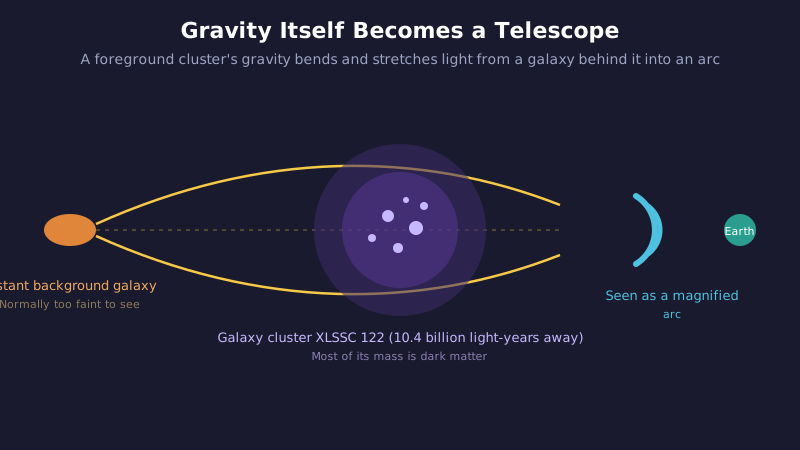
Floating 10.4 billion light-years away is a magnifying glass of absurd proportions. It isn’t made of glass at all. It’s made of gravity—the combined pull of a few hundred galaxies bending and stretching the light of something even farther away.
In 2026, JWST (the James Webb Space Telescope) spotted this “gravitational telescope” at the most distant location ever confirmed. The cluster is called XLSSC 122. And it comes bundled with a second, thornier mystery.
How gravity bends light into a telescope
Let’s start with the “gravitational telescope” part. This is a phenomenon predicted by Einstein’s general relativity, known technically as gravitational lensing—the bending of light from distant objects by the gravity of massive bodies sitting in front of them.
Anything with mass warps the space around it. Picture a bowling ball resting on a trampoline, sagging the fabric beneath it. Light traveling through that dip in space bends off its straight path, even though it’s still “going straight” as far as it’s concerned. Put something heavy enough in the foreground, and the light from whatever sits behind it gets warped—stretched into arcs, or even split into multiple images.
It’s a bit like looking at text through a glass of water: the letters distort as the light passes through. Glass and water bend light on a tabletop scale. In space, sheer mass does the same job at a scale that defies comparison.
Galaxy clusters—gatherings of hundreds to thousands of galaxies bound together by gravity, among the largest structures in the universe—carry an almost absurd amount of mass. That makes them powerful lenses, capable of magnifying the light of galaxies even farther beyond them.
Astronomers have turned this into a tool. Every telescope humans build has a size limit, but there’s no such ceiling on the mass of a galaxy cluster out in space. Distant galaxies that would otherwise be too faint to photograph get a free boost from the gravity in front of them—borrowing an extra lens the universe happens to have lying around.
And this lens doesn’t fit inside any telescope tube. A clump of mass spanning millions of light-years across does the job of a single lens. It’s simply not the same kind of object as a polished piece of glass.
So far, this is a fairly familiar story in astronomy. The real question is how far away this particular lens sits.
We’re seeing this cluster when the universe was only a quarter of its current age
XLSSC 122 sits roughly 10.4 billion light-years from Earth. On its own, that number might just prompt a shrug—“sure, that’s far.” But it’s worth pausing here.
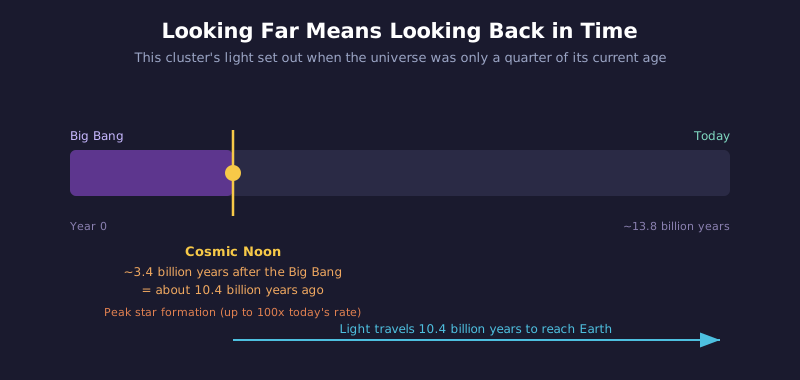
The speed of light is finite. Light from 10.4 billion light-years away takes 10.4 billion years to reach us. So what we’re seeing isn’t this cluster’s present—it’s a snapshot from 10.4 billion years ago. Looking far out into the universe means looking back in time.
How far back, exactly? The universe is roughly 13.8 billion years old. Subtract 10.4 billion from that, and you’re left with about 3.4 billion years. In other words, this light left its source when the universe was only about a quarter of its current age.
Imagine hopping in a time machine and standing next to this cluster back then. The sky would already be crowded with hundreds of galaxies, packed close together and tugging on each other’s gravity. It’s nothing like the sparse, empty sky you might picture when you hear “young universe.”
And that “already packed together” detail is exactly where the next mystery begins.
A cluster that grew up too fast, during “cosmic noon”
Astronomers call this era, roughly 10.4 billion years ago, “cosmic noon.” Think of the universe’s history as a single day: this is the busiest part of the afternoon.
Busy with what, exactly? Star formation. During this period, the universe as a whole was forming stars at a much faster clip than it does today—in some regions, up to 100 times the current rate. Galaxy clusters, too, are thought to have started multiplying around this time.
I’ll admit it: I used to picture this era as a chaotic, half-assembled universe still scrambling to gather its raw materials. XLSSC 122 pushes back on that assumption.
The standard picture of large-scale structure formation goes like this: small clumps of matter slowly pull together under gravity, merging bit by bit over enormous stretches of time. It’s like stacking blocks from the bottom up—building something big takes time. So the natural expectation is that a young universe should still have loose, poorly defined structures without a clear center of mass.
But according to the research team, this cluster’s mass is tightly concentrated at its core—far more “finished” than standard theoretical models would predict. It’s the cosmic equivalent of a newborn already built like an adult, and there’s something unsettling about that mismatch. On top of that, the cluster appears to be actively undergoing galaxy mergers right now.
How did it mature this fast? Nobody has a solid answer yet.
Invisible to Hubble, finally visible through JWST
So how did researchers confirm this “premature” maturity? The key lies in the gravitational lens mentioned earlier.
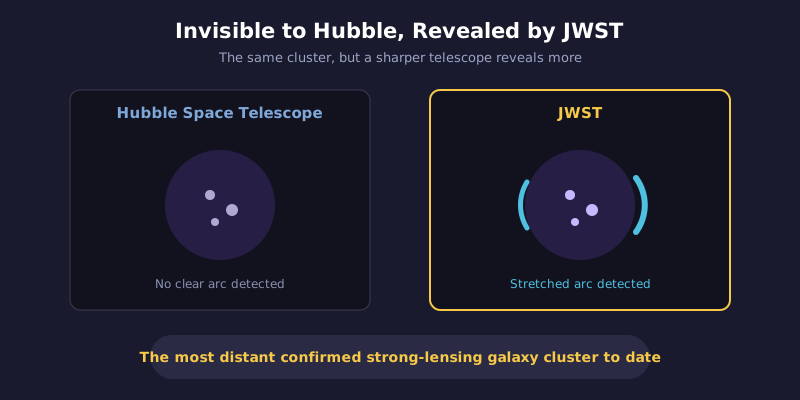
Here’s where it gets interesting: XLSSC 122 itself isn’t a new discovery. It was first spotted in 2014 by the X-ray observatory XMM-Newton during a survey. Hubble later observed it too, but never found clear evidence of lensing—no visibly stretched arcs from background galaxies.
JWST changed that. Its sharper resolution revealed arcs that had never shown up before. The research team reports that this makes XLSSC 122 the most distant galaxy cluster confirmed to produce strong gravitational lensing—lensing powerful enough to clearly distort background images into arcs or multiple copies.
The way this lens bends light lets astronomers measure the cluster’s total mass and how it’s distributed. This matters because a gravitational lens responds to all the mass present, not just the visible stars and galaxies. Most of what’s actually bending the light is thought to be dark matter—matter that emits no light and can only be detected through its gravitational pull. Read the bending pattern carefully enough, and you can map out mass you’d otherwise never be able to see.
The finding comes from a research team led by Kyle Finner of IPAC/Caltech, working with collaborators from Yonsei University. It was presented on June 17, 2026, at the 248th meeting of the American Astronomical Society, and published in The Astrophysical Journal Letters.
A universe that lends us its own gravity
One discovery, two payoffs. Use the foreground gravity as a telescope, and you can magnify an even more distant galaxy sitting behind it. At the same time, the lensing cluster itself becomes a case study in premature structure formation in a young universe. A single object serves as both instrument and specimen.
The research team frames this as a foothold for studying the cosmic noon era in more detail. With gravity as a borrowed lens, astronomers can now reach faint, distant corners of the early universe that Hubble simply couldn’t access. Are there other “too-early” clusters like this scattered through the young universe? And if so, what needs to change in how we model the growth of cosmic structure? Those answers are still out there, waiting to be found.
You don’t need to carry a single pane of glass. The universe is happy to lend you its own gravity as a telescope. Light that has traveled for 10.4 billion years gets bent and stretched by a cluster’s gravity along the way, tracing a thin arc across our field of view right now. Every one of those arcs is a dispatch from the busiest afternoon the universe has ever known.