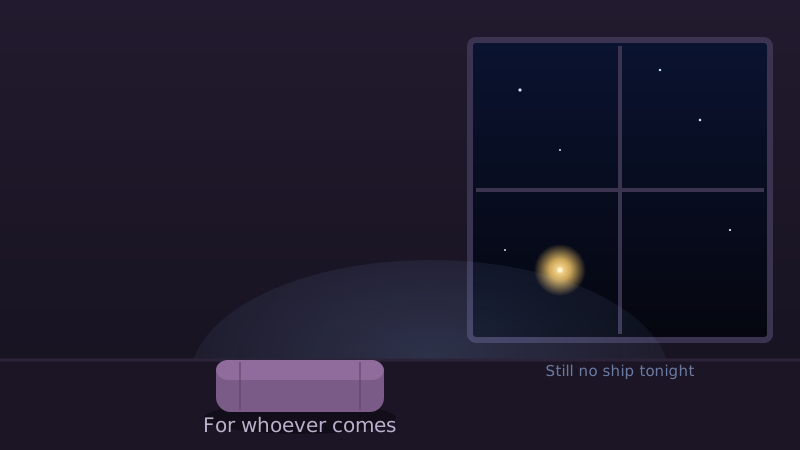
Every night, Mina lays a single cushion down in the coldest corner of the house.
“It’s for whoever comes,” she says.
The corner sits beneath a big window, and beyond the glass is a dark, empty dock. Once night falls, a thin draft creeps through that spot alone — the coldest place in the whole house, hands down. Nobody else wants it.
Mina seems to like it anyway. She squares the cushion’s corners just so, turning it the same direction every night. It’s their mother’s cushion, its color long since faded.
“Doing it again.”
Nao, her older sister, sighs. Fifteen now, she wears the look of someone who outgrew this sort of thing ages ago.
“Mina. Nobody’s coming. How many times do I have to say it?”
“She’ll come.”
“She won’t. It’s been six months since any ship stopped by.”
“When she does come, she’ll need somewhere to sit.”
That’s all Mina says before straightening the corners again. Nao heads for the kitchen with a face that gives nothing away.
The neighbors seem to think Mina is waiting on some important guest. She isn’t.
Their mother works at an ice mine, far, far away. The ships that bring people home from there don’t run on any timetable — they don’t arrive at set hours at all. A ship just happens to be passing nearby, and on a whim, it swings in to dock. That’s the whole story. A ship can’t alter its own path, so it can only stop here when that path happens to curve this way. Even the crew, most likely, can’t say exactly when that will be.
So their mother can never write “I’ll be home tomorrow,” or “next month.” Once, when Mina was still a baby, and three more times that Nao can remember, their mother turned up out of nowhere. Never any warning. At night, a lone light appears in the dark glass — a ship, drifting home. And the first window in the house that light ever touches is the one above that corner. That’s why it’s the coldest spot: it sits closest to the darkness outside.
That night, no ship came either.
Mina sat by the cushion for a while. Then she brushed her teeth as usual and went to bed as usual, not looking disappointed in the least.
To Nao, that was the strange part.
“Hey, Mina.” Under the blankets, Nao asked it quietly. “Doesn’t it make you sad? When she doesn’t come?”
“Huh?”
“Mom. She didn’t show up again today.”
Mina thought it over for a moment.
“If she comes on a day there’s a place to sit, that’s enough.”
”…And on the days she doesn’t?”
“Those days, I just leave it open.”
Nao stared up at the ceiling. The words wouldn’t come.
The truth was, it used to be Nao who laid a cushion in that corner every night. After their mother came home the third time and left again, Nao had stopped. Wait, and no one comes — do that enough times and it wears you down. She’d had enough of it. If you don’t wait, it can’t disappoint you. So Nao made a habit of saying “she’s never coming.” Say it often enough, she figured, and it wouldn’t sting even when it turned out to be true. Though she never mentioned that pretending not to care was the most exhausting thing of all.
The next evening, when Mina came out to the porch, the cushion was already there — corners squared neatly in the corner. Nao sat gazing at the dark window.
”…It was just lying around, that’s all.”
Mina didn’t say anything. She just sat down beside her.
From that night on, it was Nao who laid the cushion out first. And Nao who spent the longest stretch of every evening watching a window with no ship in it.