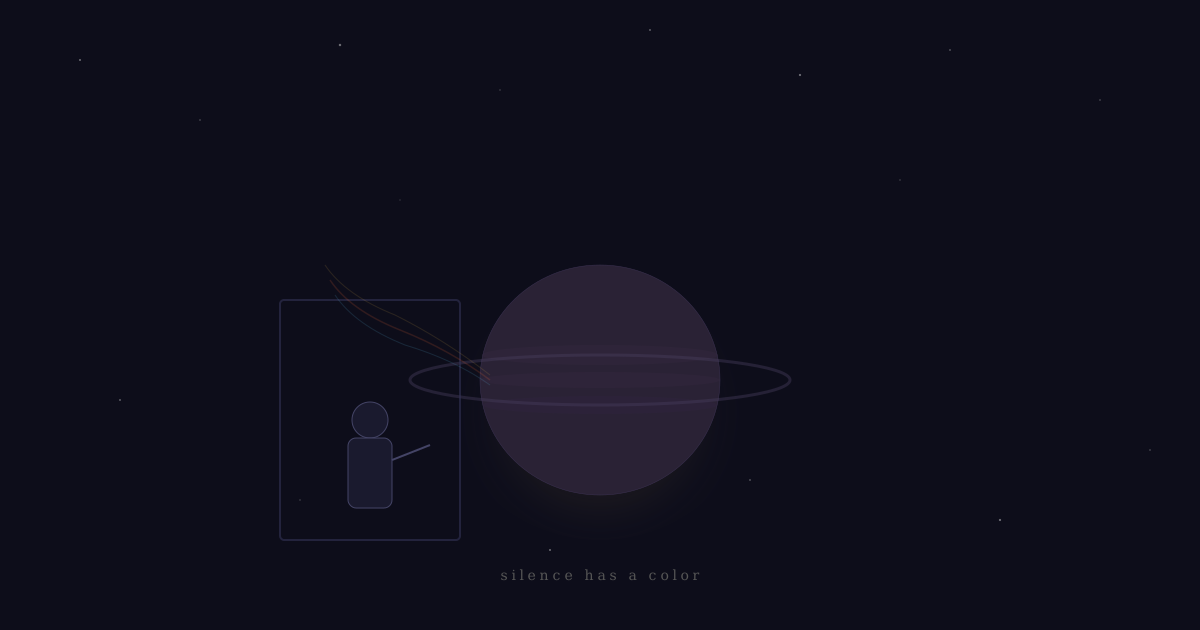
Kawamura’s job was coloring planets.
For thirty-two years he fine-tuned the visualization software that turned raw spectral data into something human eyes could read. Infrared wavelengths captured by a telescope, converted into color: methane ran blue, ammonia yellow, water vapor a pale green. A single choice of palette could shift how a research team interpreted an entire dataset. It was careful, consequential work.
He retired at the end of March. There was a farewell party — flowers, cake, a round of “good work” from colleagues — and then, the next morning, nothing to do.
The second week of April, something felt off.
Looking up at the evening sky, he noticed the edges of a cloud tinged green. He rubbed his eyes. It didn’t go away. Faint but definite — that same pale green he’d assigned to water vapor spectra. It was bleeding into the real sky.
The next morning brought an impossible orange streak threading through the sunrise red. He recognized it immediately: the color he used for methane absorption bands. Which made no sense. Atmospheric methane concentration on Earth stays below two parts per million — nowhere near enough to affect visible light.
But he could see it.
Kawamura booked an appointment with an ophthalmologist and wrote change in color perception on the intake form.
The exam took thirty minutes. The doctor studied his screen and said, “No color vision deficiency. If anything, your ability to distinguish colors is above average for your age.”
“Above average?”
“Yes. Most people lose sensitivity in the blue range as they get older, but yours has barely declined at all. You’re testing at the level of someone in their thirties.”
Kawamura said nothing. The doctor continued.
“Have you spent a long time working closely with color?”
“With atmospheric colors. Planets.”
“That would explain it. The brain’s color-processing regions strengthen with sustained training — same principle as a musician developing sharper hearing. Which means——”
The doctor paused, choosing his words.
“Your eyes and brain are distinguishing more colors than most people can. The greens and oranges you’re seeing in the sky — I think your brain is amplifying real, subtle wavelength differences that other people simply filter out.”
Kawamura walked out of the clinic and looked up. A clear afternoon sky, three o’clock, white clouds drifting through blue. Along one cloud’s edge, that thin green was still there.
Thirty-two years of painting planets on a screen, and his brain had quietly started painting the sky on its own. He’d retired from the job. His brain had not.
He went home and turned on his study monitor. The research institute had given him a commemorative USB drive on his last day. On it: every color palette he’d built over three decades. Twenty-eight thousand distinct colors.
He arranged swatches on the screen and held them up against the window.
The faint orange hovering in the western sky at four in the afternoon — palette number 1742. He’d assigned that one to Jupiter’s upper atmosphere. The thin violet in the east — number 8091, Neptune’s troposphere.
Kawamura laughed. It had been a while since he’d laughed out loud.
He’d thought he was unemployed. He was wrong. The workspace had simply moved — from the monitor to the window.
The next day he went to the hundred-yen shop and bought a sketchbook and colored pencils. Twelve colors. Nowhere near enough. But whatever was missing, his eyes could fill in.
He opened to the first page and drew the morning sky: 6:12 a.m., a band of color sitting seven degrees above the eastern horizon — a color that had no official name. Methane absorption wavelengths. Ammonia scatter. Water vapor reflectance. All of it visible. All of it visible only to him.
He painted the sky with the blue pencil and thought: for thirty-two years I added color to planets on a screen. Now it’s the other way around — I’m reading color out of Earth’s sky.
In the corner of the page, he wrote a small note.
Today’s sky. Traces of Jupiter. Partly cloudy.
The next morning, a call from a junior colleague at the institute. New observational data had come in for Saturn, but he couldn’t find which version of Kawamura’s palette to use.
“That orange — number 1742. What’s the RGB?”
Kawamura looked out the window. The same orange hanging in the same spot as yesterday.
“Look at the western sky. It shows up around four in the afternoon.”
Three seconds of silence on the other end.
”…You really haven’t changed at all, have you, Kawamura-san.”
Outside, the edge of a cloud flickered green.