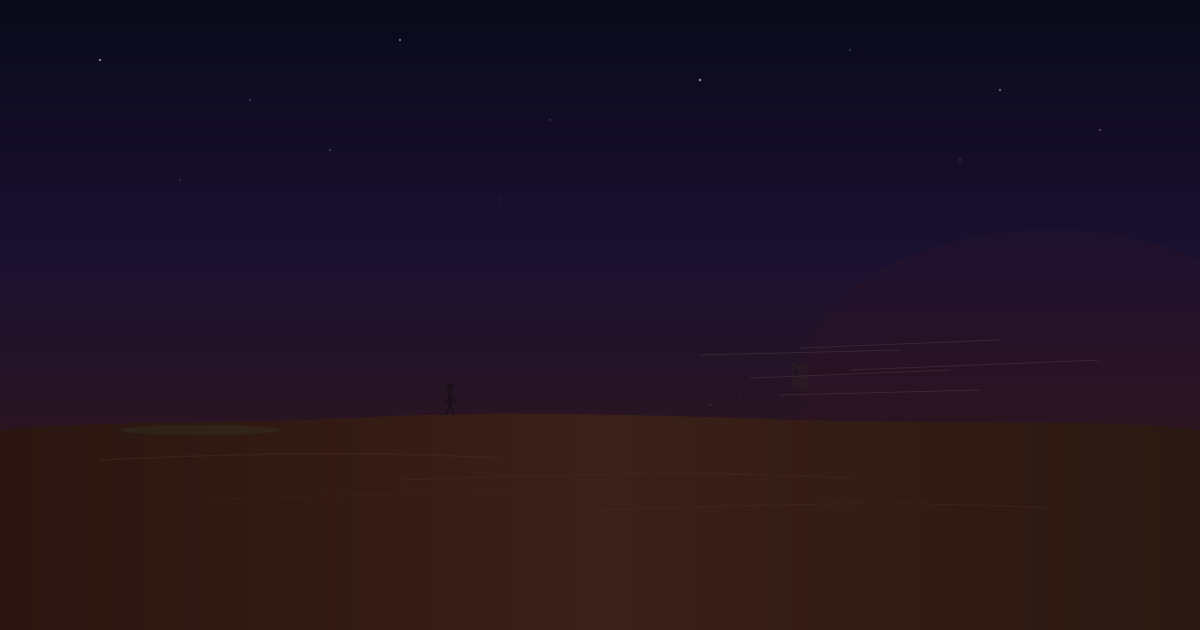
The wind disappeared from our town three years ago.
To be precise, the wind itself didn’t disappear. If anything, it got stronger. But it stopped being something born inside the town. Now it only came from outside, driving in from one direction and taking everything with it.
I grew up in the Amari district, on the edge of town. From the fields on the hilltop you could see silver grasslands stretching all the way to the horizon, and in the evenings the grass would shimmer and roll like a slow wave. I learned later, in school, that those waves were made by convection rising from the ground — warm air lifting off the sun-heated surface, mingling with the cold air above, becoming a gentle breeze.
Three years ago, the wind turned.
The convection from the south vanished, replaced by a hard, steady gale out of the east. At first everyone assumed it was a seasonal shift. But the wind didn’t stop. Not through spring, not through summer. The eastern wind kept accelerating, and eventually it tore the silver grass out by its roots.
My father, who farmed that hill, was one of the first to notice something was wrong.
“The topsoil is blowing away,” he said. The wind was picking up the earth and carrying it east. Fine sand at first. Then gravel. Then whole layers of the tilled surface, gone.
The mayor brought in specialists. They talked in numbers and used the phrase “environmental flow.” The ultra-hot gas streaming outside our town was accelerating, they explained, and its fluid pressure was stripping our town’s material away behind us.
I didn’t follow any of it. But my father seemed to understand, because he went quiet and sat down at the dinner table without a word.
Within six months, half the population was gone. People left district by district, starting from the east side. The destination was Olga, a district closer to the galaxy’s center, where they said the wind hadn’t hit as hard yet.
“It’s only a matter of time for Olga too,” said Muta, our neighbor. Muta was an old man who tracked weather as a hobby, with a row of homemade instruments mounted on his rooftop. “The wind isn’t weaker there. It just hasn’t arrived yet.”
I was twelve when the Amari elementary school closed. My class had seven students; then three; then one morning I came in and the room was empty. The teacher had written something on the blackboard in chalk: Please arrange transfer to Olga District Third Elementary School.
I remember the day my father and I climbed the hill together. Where the silver grasslands used to be, red-brown bedrock lay bare. Not just the topsoil — the sediment layers beneath it had been scraped away too.
“It’s beautiful,” my father said.
I didn’t think so. But it was unlike anything I’d ever seen. Millions of years of accumulation, stripped back in a few years, and the original terrain underneath had appeared — red stripes in the rock, like a memory of what this land looked like when it was young.
Last year, the final bus came. My father and I moved to Olga. He started a new field there, but he doesn’t talk about farming the way he used to.
Last month, for a school assignment, I looked up the history of our town. I found an old geological map. It said our town — this whole galaxy — is in the middle of falling into a much larger cluster. The ultra-hot fluid that fills the cluster is peeling our galaxy’s outer layers back, streaming them away behind us.
The textbook put it plainly: Given sufficient time, a galaxy stripped of its gas loses the ability to form new stars.
In the evenings in Olga, if I open the window, a breeze comes in. Still gentle. Convection still works here — the ground warms, the air rises, the grass rolls in waves.
But the sky to the east is a little redder than it used to be.
Muta’s instruments finally broke last month, he wrote in a letter. The wind got to them in the end. But at the bottom of the letter he had included his last recorded measurement.
Wind speed: still accelerating. No sign of deceleration.
I closed the window. School tomorrow. I’ve made new friends. I like it here.
But sometimes I catch myself thinking about it — what name this town might get, after the wind takes everything.
The “environmental flow” in this story is based on ram-pressure stripping, a real process in which the ultra-hot intracluster medium (ICM) filling a galaxy cluster tears gas from infalling galaxies. The protagonists’ galaxy is a jellyfish galaxy — one currently being stripped as it plunges into the cluster.