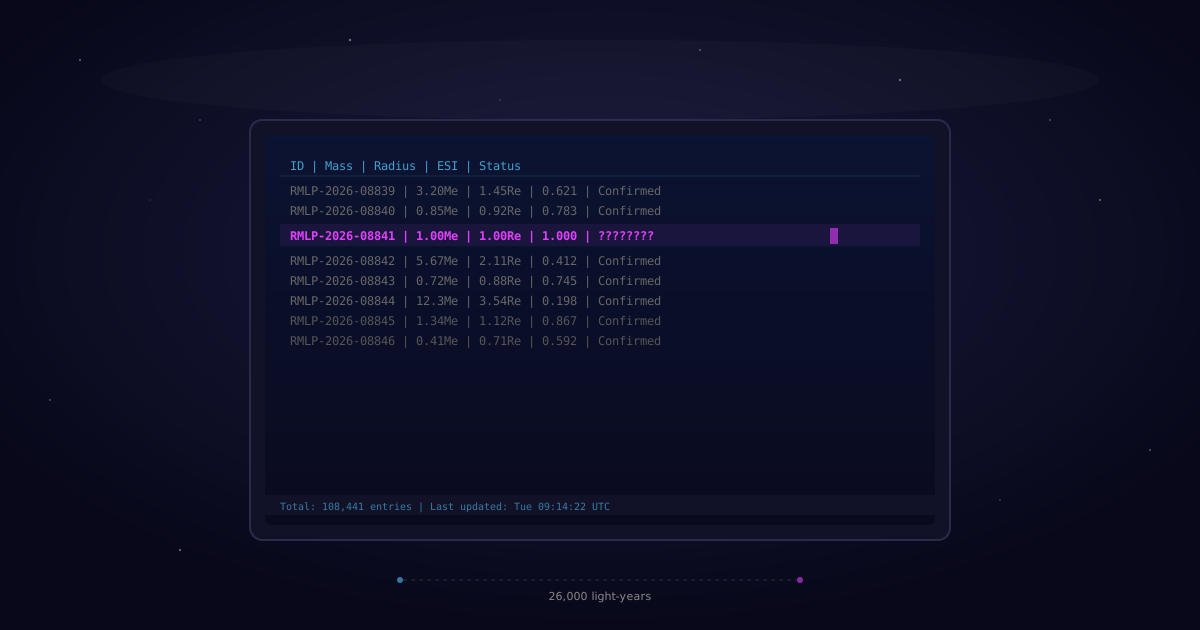
I update the exoplanet catalog every Tuesday morning.
The automated detection algorithm processes a week’s worth of observation data and flags new planetary candidates. My job is to go through them one by one, decide whether each one makes the cut, and register it. That’s it.
Once the count crossed a hundred thousand, the work got monotonous. Three hot Jupiters, seven super-Earths, twelve mini-Neptunes. Check the parameters, cross-reference against known planets, hit register. Repeat.
That Tuesday was no different.
Until entry number 127.
The host star: spectral type G2V. Mass: 1.00 solar masses. Orbital semi-major axis: 1.00 AU. Orbital period: 365.25 days. Planetary mass: 1.00 Earth masses. Radius: 1.00 Earth radii.
ESI — Earth Similarity Index — 1.000.
My first thought was a bug. Test data had leaked into the pipeline. An ESI of 1.000 can only belong to Earth. That’s not an observation — it’s the definition.
I pulled the logs. The data was real. Late the previous night, the Roman Telescope’s microlensing survey had picked it up. Coordinates: toward the galactic center. Distance: roughly 26,000 light-years.
I showed it to Kawamura. He stared at the screen for about thirty seconds.
“Coincidence,” he said. “Not enough significant figures. The actual mass is probably 1.003, or 0.997. Precision has limits.”
He wasn’t wrong. Looking the same as Earth and being the same as Earth are very different things. I registered the planet, gave it the provisional ID RMLP-2026-08841, and moved on. No special treatment.
The following Tuesday, the algorithm returned with additional data on RMLP-2026-08841. Atmospheric spectral analysis had come in. Nitrogen: 78%. Oxygen: 21%. Argon: 0.93%. Carbon dioxide: trace amounts.
My fingers stopped.
That’s Earth’s atmosphere. Not approximately. Exactly.
This time, Kawamura didn’t laugh.
“Let’s apply for JWST follow-up,” he said.
It took six weeks for the application to go through. JWST observing time is a war. But when the review committee saw the atmospheric composition data, they allocated time with unusual speed.
The results arrived on a Tuesday morning, two months after we applied.
Methane and oxygen coexisting in the atmosphere. That’s a powerful biosignature. Abiotic processes can’t sustain both gases at once — each reacts with and destroys the other. For both to persist, something has to keep replenishing them.
On top of that, the estimated surface temperature: 15 degrees Celsius. A very high probability of liquid water.
The research team ballooned. Draft papers started circulating. We had to publish before the media started screaming “second Earth discovered.”
I kept updating the catalog. I left the papers to everyone else. My job is registration.
At some point, a thought surfaced.
I converted RMLP-2026-08841’s coordinates to galactic coordinates and calculated the view from the other direction — specifically, what direction our solar system would appear from that planet.
26,000 light-years. Almost exactly opposite us across the galactic center.
If there are intelligent beings on that planet. If they also compile a catalog of exoplanets. If their telescopes have turned toward a small yellow star on the far side of the galaxy —
The third planet of that star would appear in their catalog like this:
ESI: 1.000.
I took a sip of coffee and moved on to entry number 128.