Sachi was the type who always stopped in front of the most expensive shelf in any toy store, and this year was no different.
Her grandson Kou lives on Mars. His parents’ work took the family there when he was three. Seven years now. Cargo flights to Mars only launch twice a year, one-way, so a birthday present has to ship six months ahead just to land on time.
That’s why Sachi always plans early and goes for the best thing on the shelf.
“Is this the bestseller right now?” she asked the clerk.
“Oh, that one transforms five different ways. Robot, car, and at the end it runs on two legs.”
The shelf tag read “5-STAGE TRANSFORMATION” in red letters. Last year’s model only had four stages. Sachi, for her part, has never once managed to remember how the transformation sequence actually works.
“Will it run okay on Mars?”
“Hmm, gravity’s weaker out there, so the legs might wobble a bit. But yeah, it’ll run.”
She bought it and spent the better part of six months getting it shipped.
On the next return flight, a short reply came back from Kou. He still wasn’t great at typing, so his messages were always one line.
“I rolled it. it was fun.”
Not ran it. Something about that snagged in her mind, but she told herself: if he had fun, that’s what matters.
The following year she sent the six-stage model. The reply came back the same: “I rolled it.” The year after that, the toys grew more arms, more joints, until one of them could even fly on its own — but the words coming back from Mars never changed.
I rolled it. Rolled it again today.
Maybe Kou didn’t understand how the transformations worked. She always included the instructions. Still, she kept catching herself thinking she should send something simpler. And yet every time she walked into the store, her feet carried her right back to the fanciest shelf.
In the spring of the seventh year, a package addressed to Sachi arrived from Mars — a rare thing.
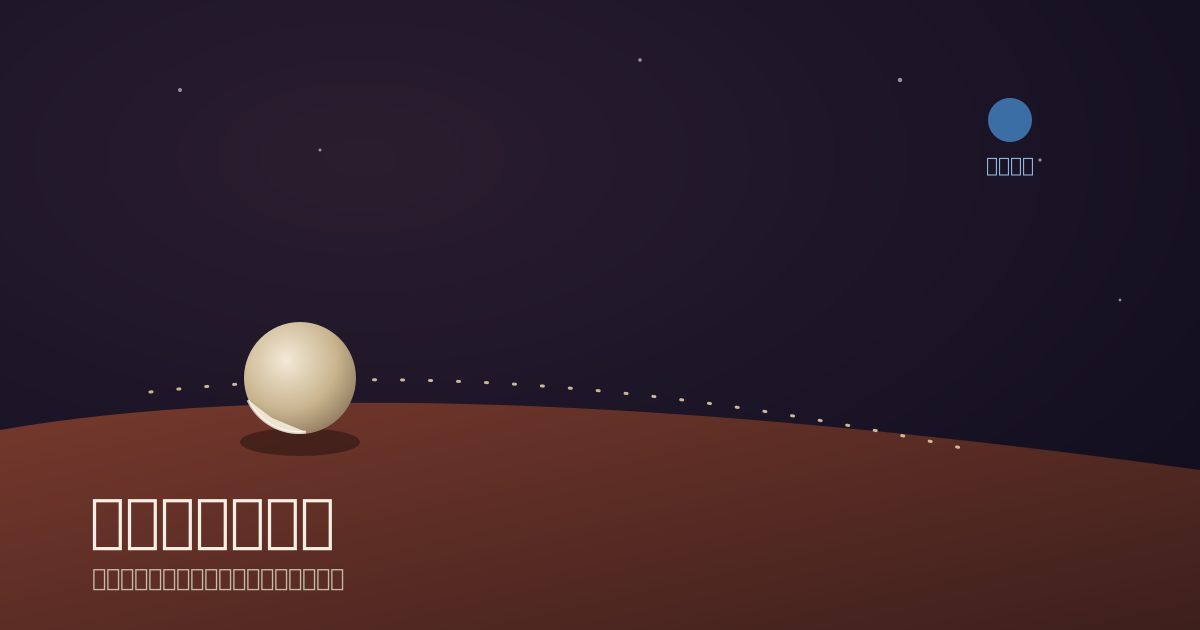
The box smelled faintly of dust. Inside was the very first transforming robot she’d ever sent. The arms and legs looked untouched, the joints still factory-fresh. But the outer shell — the part that became a sphere when folded into ball mode — was worn smooth and pale on just one side. The same spot, the same angle, scraped down to a shine.
A short letter was tucked inside. Kou’s handwriting.
“i rolld it evry day on the slope behind our hous. in the mornin, wen grandma wakes up. im big now so im sending this bak to grandma.”
Sachi turned the ball over in her palm. The worn patch fit perfectly against the curve of her thumb. This was the face that had rolled down a Martian slope, in the same direction, every single morning, hundreds of times. On low-gravity slopes, a ball doesn’t stop rolling easily — it must have traveled a long way each time. For the first time, she pictured small feet running after it, every morning, to bring it back.
The arms, the legs, the flight unit — none of it had ever mattered. All Kou had ever wanted was something that rolled well.
For the next flight, she went back to the store. This year she walked straight past the fanciest shelf. In a cheap bin by the register, a plain wooden ball sat among the clearance items. No paint, no features. Just round.
“That one doesn’t transform,” the clerk said.
“That’s exactly what I want.”
Sachi packed the ball — no transformation buttons, nothing but its roundness — into the box, and on the shipping label, where it asked for the item name, she wrote, slowly: A thing that rolls.