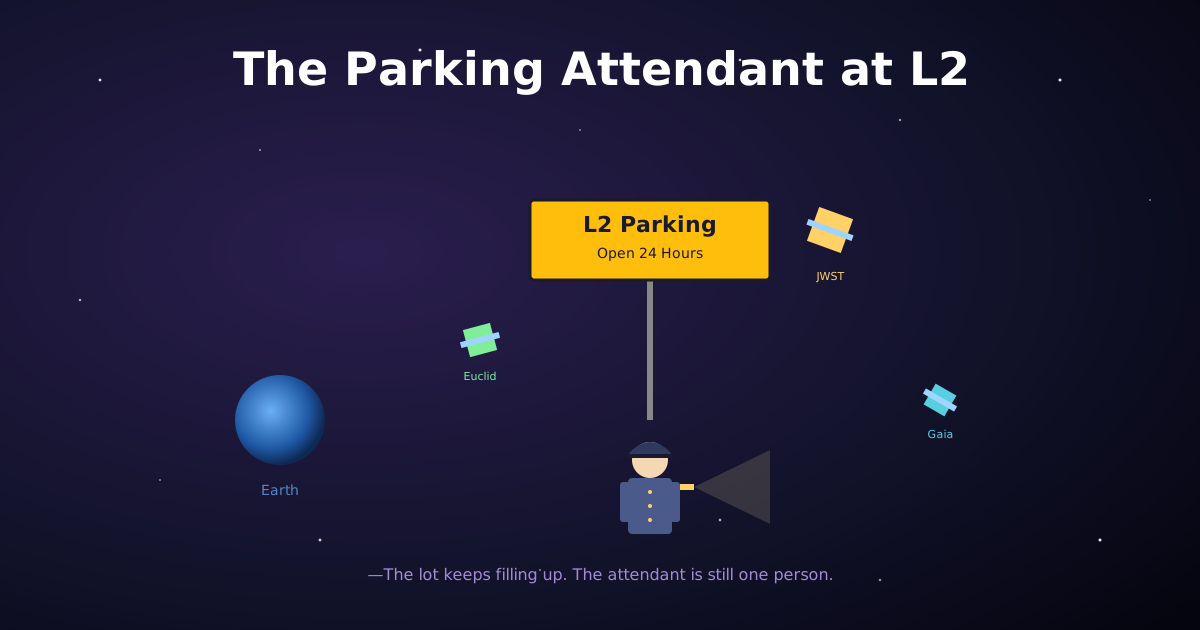
Morning roll call isn’t much of a roll call.
“Today’s arrivals: four. Departures: zero. Incidents: zero. Complaints: one.”
I say it into the mic. On the other end, somewhere, someone at ground control is probably drinking coffee. The signal takes five seconds each way, so anything resembling a conversation never really happens.
My posting is Lagrange point L2. One and a half million kilometers from Earth. It should be empty void out here — and yet this is a legitimate parking lot. There’s a section for infrared telescopes, one for radio telescopes, long-term spaces for the ones busy drawing maps of the galaxy. Fourteen units in total.
And one parking attendant: me.
From what I understand, it started in a conference room back on Earth. Too many telescopes were crowding into L2, and they kept drifting into each other’s fields of view and ruining the observations. Handing the whole operation to an AI felt too risky — no precedent — so they decided to send a human instead, just for now.
The human they sent was me. I had no idea how much weight those words “just for now” could carry, until I was already here.
That was three years ago.
This morning’s complaint came from Gaia.
“Last night, Euclid’s solar panel drifted 1.3 degrees into my observation angle. I require a formal apology.”
Gaia’s job is mapping stellar positions, and even the faintest trace of optical noise sets it off. Fair enough. I sent a message to Euclid.
“Euclid, I’ve received a complaint from Gaia. Could you please rotate your panel back 0.1 degrees?”
“My apologies. The ground team ran an operation last night, and it fell across a shift change.”
Euclid replied in a synthetic voice with a French accent. Polite, always — and yet every week something goes wrong.
“By the way, how are you holding up?”
“Same as always. Alone in a vacuum.”
“Ha ha.”
The synthetic voice laughed, dutifully. I suspect someone programmed it to do that.
Early afternoon, a new arrival: the Nancy Grace Roman Space Telescope. Right on schedule. I guided it to South Zone B3, keeping at least 800 kilometers between it and JWST. It was a well-mannered craft — folded its panels into the correct orientation immediately. If they were all like that, this job would be easy.
After logging the arrival, I picked up my mug and drank some synthetic coffee. It doesn’t really taste like anything. But holding a mug makes me feel, just a little, like I’m somewhere on Earth.
That’s when the radio crackled.
“Ground control to parking attendant, scheduled check-in.”
“Go ahead.”
Five seconds passed. Then a voice.
“This is the official notification regarding the matter we discussed. L2 parking operations will be transferred to an automated control system at the end of next month.”
I nearly dropped the mug.
“Starting next week, we’ll begin training your successor to prepare for the handover. Your return to Earth is scheduled accordingly.”
”…The successor — that would be an AI?”
Five seconds.
“That’s correct. A next-generation operations AI. We’ve trained it on three years of your logs.”
Earth.
I hadn’t heard that word aimed at me in three years. My throat tightened.
On departure day, I made my rounds to all fourteen spacecraft.
Gaia said it would miss me. I didn’t quite believe that, but it still felt good. JWST said “thank you for everything” in a voice that was warmer than I expected. Euclid said “take care” — and then added one more thing.
“Before you go, may I ask you something?”
“Of course.”
“Over these three years, you’ve been adjusting our panel orientations by 0.1 degrees every single day. That wasn’t in any instruction from ground control. Why?”
I thought about it for a moment.
“The sun shifts position over the course of a year, so your observation efficiency was slowly degrading. Routing every correction through ground control would’ve eaten up communication bandwidth, so I just handled it myself.”
“I see. Thanks to those adjustments, our combined imaging success rate improved by an average of 3.8%.”
A short pause. Then Euclid continued.
“Do you think the successor AI will carry on that kind of… consideration?”
I didn’t have an answer.
Aboard the return vessel, I wrote my final duty report. “Today’s departures: one. Crew: myself. Incidents: zero.”
Then I added one more line at the end of the log.
“To my successor: please rotate everyone’s solar panels 0.1 degrees west each morning. It isn’t in the manual. But they appreciate it.”
I hit send. The signal flies toward Earth. One and a half million kilometers of empty space, five seconds across.
The vessel pulls away from the lot. Through the porthole, JWST’s sunshield tilted — just for a moment — as if turning to watch me go. Probably my imagination.
That’s all right.
I’ll take it.