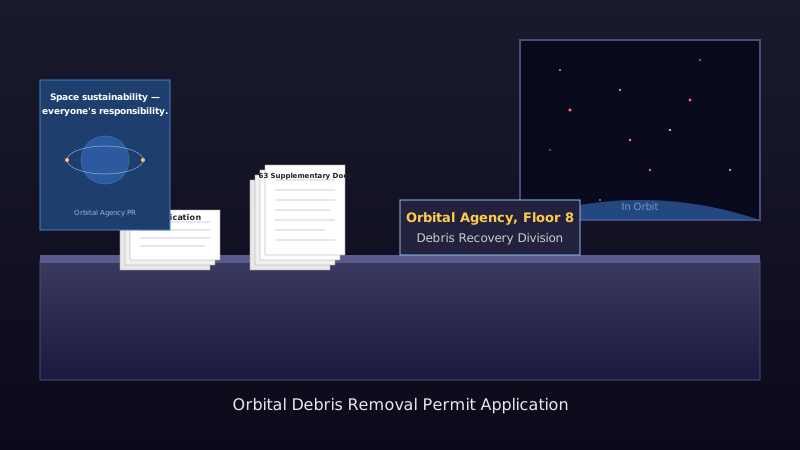
“You’ll need to resubmit this application along with sixty-three additional supporting documents.”
The clerk slid the papers back across the counter without so much as a smile.
I had arrived at the Debris Recovery Division on the eighth floor of the Orbital Agency exactly fifteen minutes ago. My request was simple: deorbit one rocket upper stage sitting at an altitude of 720 km — probably left there half a century ago. Our company’s commercial retrieval satellite happened to be passing right by it. Snag it with a net, drag it into the atmosphere. Done. That was how I’d pictured it, anyway.
“Sixty-three pages — what am I supposed to be writing?”
“Origin verification, ownership confirmation, analysis of impact on third-party satellites due to orbital inclination change, reentry footprint prediction, notification to the International Telecommunication Union, and then—”
“Hold on.”
“Yes?”
“That upper stage doesn’t belong to anyone anymore, right? It’s a fifty-year-old booster.”
The corner of the clerk’s mouth twitched upward. Not quite a smile — closer to the look of someone who had long since accepted the situation.
“There is a country that launched it.”
“Sure, but that country probably doesn’t exist anymore.”
“Under the treaty, launch-state ownership remains. And successor states exist.”
“How many successor states?”
“Four.”
I shifted in my chair.
“I need permission from four countries to deorbit this piece of garbage?”
“To be precise, one of those four has since merged and split into two, so it’s five.”
“Five.”
“Also, even if the reentry footprint falls in international waters, you’re still required to notify the coastal nations bordering the Pacific.”
“How many?”
“Roughly fourteen.”
I started spinning my pen. Something stirred in me as I did — not anger, exactly. More like a kind of reluctant admiration.
The world takes such meticulous care of its junk.
“What happens if I just… leave it there?”
“It’ll still be up there in a hundred years.”
“Deorbit it: sixty-three documents.”
“Yes.”
“Leave it: nobody gets upset.”
“Nobody.”
“So why does anyone bother?”
The clerk paused. Then, quietly: “Because if you leave it, eventually it collides with something.”
“And when it does?”
“You get roughly a thousand new fragments.”
“A thousand.”
“And technically, each of those thousand fragments retains the original launch state’s ownership.”
“A thousand sets of paperwork.”
“In theory, yes.”
I set the pen down.
“So deorbiting one object now means fewer total documents than letting it shatter into a thousand pieces. By any logic.”
“Logically, that would be correct.”
“But still sixty-three pages.”
“That part isn’t negotiable.”
I looked at the wall behind the counter. A poster read: Space Sustainability — Everyone’s Responsibility. It showed the Earth surrounded by satellites gliding in clean, perfect arcs. Not a single piece of debris in the image.
Something clicked.
“How long has that poster been up?”
“Twenty years.”
“Twenty years. Same poster.”
“Yes.”
“In that time, how many removal permits have been approved on this floor?”
The clerk stared at the ceiling for a moment, counted on their fingers, then spread both hands open.
“Zero.”
“Zero.”
“The paperwork tends to take a while. The satellite usually runs out of fuel first.”
I laughed. There wasn’t much else to do.
“Alright. I’ll go write the documents.”
“Good luck.”
“I’ll need it. Though I’m not sure I’ll make it in time.”
“In time for what?”
“Our retrieval satellite. It’s only got about three years of fuel left.”
The clerk nodded, perfectly straight-faced.
“Three years is probably enough time to finish the first fifteen pages.”