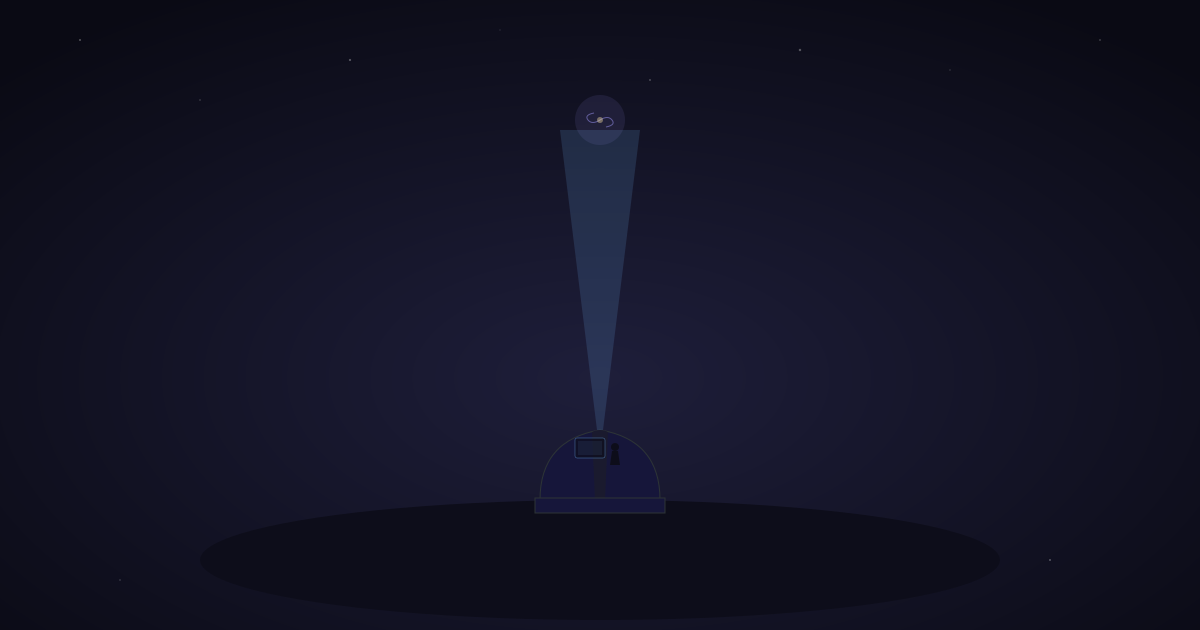
Thirty-four years at a mountaintop observatory, doing the same job.
The telescope ran itself — computers handled all of that. My job was the building. HVAC checks, dome lubrication, snow removal. The astronomers observed remotely, so most nights it was just me up there.
Tonight was my last shift. No replacement coming. Starting next month, fully remote operation.
I finished the handover paperwork at two in the morning. Then I did something I wasn’t supposed to do. I switched the telescope to manual mode. First time in thirty-four years.
I thought for a moment about where to point it, then chose Saturn. Thirty-four years ago, the chief researcher at the time had said, “You’re here anyway — want a look?” and showed me. I still remember going speechless at those rings on the monitor.
I entered the coordinates. The dome rotated. The low hum of the motor traveled up through the floor. I wouldn’t feel that vibration again.
Saturn appeared on the screen. Same as it was thirty-four years ago. A pale yellow sphere, thin rings. The Cassini Division. A few moons clustered nearby, tiny points of light.
Beautiful, I thought.
After about fifteen minutes, I shifted the coordinates. Toward Virgo. Thirteen billion light-years out. A primordial galaxy one of the younger researchers had found with this very telescope last year — spiral structure already forming just 1.5 billion years after the Big Bang. I hadn’t read the paper. I’d heard the researchers talking about it, all excited, while I was swapping out an air filter.
A faint speck of light appeared on the screen. Thirteen-billion-year-old light. When that light left its source, Earth didn’t exist yet. The Sun didn’t either.
Here I was, a retiring caretaker, sneaking a look at it. Something about that struck me as funny. It wouldn’t become a paper. It wouldn’t contribute to any finding. All I’d done was think, beautiful.
I returned the telescope to its original position and released manual mode. I didn’t delete the operation log. There was no reason to hide what I’d seen.
Four in the morning. Before I killed the dome lights for the last time, I ran through the operation log out of habit. End-of-shift daily check. Something I’d done every night for thirty-four years.
I opened the log. My fingers stopped.
I had switched to manual at 2:14 a.m. Saturn first, then the primordial galaxy, then back — done by 3:28 a.m. That matched.
But there was one more line below it.
1:51 a.m. Manual mode. Coordinates: the same primordial galaxy in Virgo I’d entered later. Duration: four minutes. User ID: MAINTENANCE_01.
My ID.
The timestamp was wrong. At 1:51 a.m. I was still in the office, writing handover documents. I hadn’t touched the telescope.
I read the log again. No sign of deletion or tampering. The timestamp synced to the NTP server. At 1:51 a.m., someone had used my credentials to look at that galaxy for exactly four minutes.
I looked up at the telescope. The enormous mirror glinted dully in the darkened dome. The mirror I’d polished every day for thirty-four years.
Four minutes. Apparently, this telescope couldn’t wait until I finished my paperwork.
I locked up and stepped outside. The eastern sky was just beginning to lighten. Before I got in my car, I looked up one more time — toward where that galaxy sat — but there was nothing to see with the naked eye.
In my pocket, the stack of handover documents rustled softly. I pulled them out and added one line at the top, in red pen.
“The telescope sometimes looks at the sky on its own.”
I pictured the contractor who’d read that and tilt their head in confusion. I started the car. In the rearview mirror, the white dome of the observatory was flushing pink with the dawn.