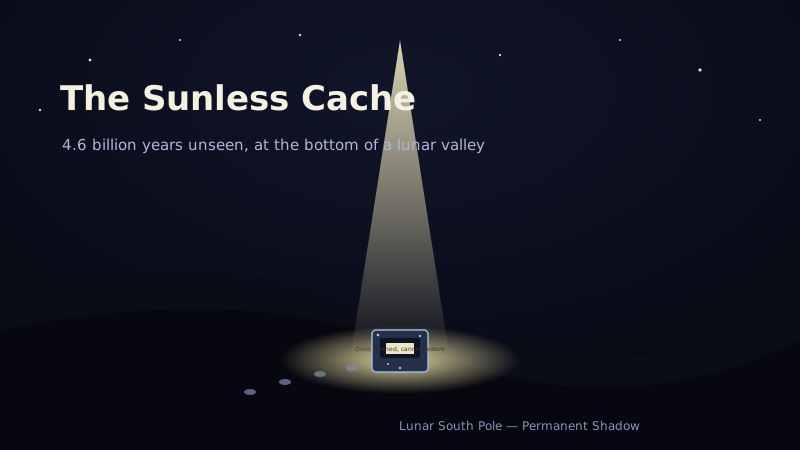
Kitami is, for all practical purposes, a regular office worker. Her workplace just happens to be on the lunar south pole.
On the lunar south pole, there are valley floors where sunlight never reaches, no matter how the sun tilts. The bottoms drop well below minus two hundred degrees Celsius and have stayed dark for 4.6 billion years. No one has ever seen them. Deep inside one such pit — labeled nothing but “Crater Basin No. 3” on the maps — an old cache unit had been left sitting, forgotten.
Kitami’s job was to log that unit’s output each month. Alone in its cold, lightless pit, the cache quietly produced something valuable, a few grams at a time. Who put it there, or why, the records no longer said. But every month, without fail, a certain number of grams showed up on the ledger, and all Kitami had to do was copy the figure into her spreadsheet. For three years running, headquarters had named her an “Outstanding Asset Manager.”
Not that anyone from headquarters had ever descended into that pit. Neither had Kitami. There had never been any reason to. On the cache’s door, a single handwritten slip of paper survived from the previous administrator. It read: Once opened, cannot restore. Kitami had always found that vaguely ominous.
“Kitami, got a minute?”
One day, Section Chief Hayami came through on comms. When Hayami called Kitami, it usually meant a headache was on the way.
“That cache unit — I want to make it visible.”
“Visible?”
“Yeah. New policy from HQ: every managed asset gets camera monitoring. If it’s producing results, we want to see it producing results. The fact that nobody’s ever laid eyes on what’s happening in there is, you know. Kind of.”
“Kind of what?”
“Just go ahead and lower some lights and a camera. Starting next month, video reports.”
Kitami had no choice. She gathered the equipment and descended into Crater Basin No. 3, becoming the first human being to leave footprints on that floor. When she switched on her light, the valley bottom lit up for the first time in 4.6 billion years. The cache was there — smaller than she’d imagined, caked in frost, thoroughly unremarkable. She set up the camera and glanced at the door’s note — Once opened, cannot restore — and let out a small laugh.
The following month, the output was zero.
The month after that: zero again. The cache sat in bright light, crisp and clear on camera, and made nothing at all. Apparently, the bottom of a pit where someone was watching held no appeal for production.
“Zero output, huh,” said Hayami. “So it was never really doing anything to begin with. I’ll flag it for decommissioning.”
Kitami scrambled. She killed the lights, pulled the camera, and tried returning the pit to darkness. But the cache never ran again. A floor that had once taken in light was no longer a permanent shadow, whatever she did. She could make it dark, but she could not erase the 4.6-billion-year-old footprints, or the memory of the very first light. This was already a place that someone had seen.
Kitami went back to the base and spread out a map of the lunar south pole. Besides Crater Basin No. 3, several other pit floors still sat black on the chart — places no one had descended into yet. She filed a report to headquarters: “Relocation site: under review.”
Then she quietly drew a circle around a valley floor that didn’t even have a name yet.
There really are valley floors on the lunar south pole where sunlight never reaches, no matter how the sun tilts. Sealed in extreme cold for billions of years, they are the closest thing in the universe to a place that has simply always been dark.