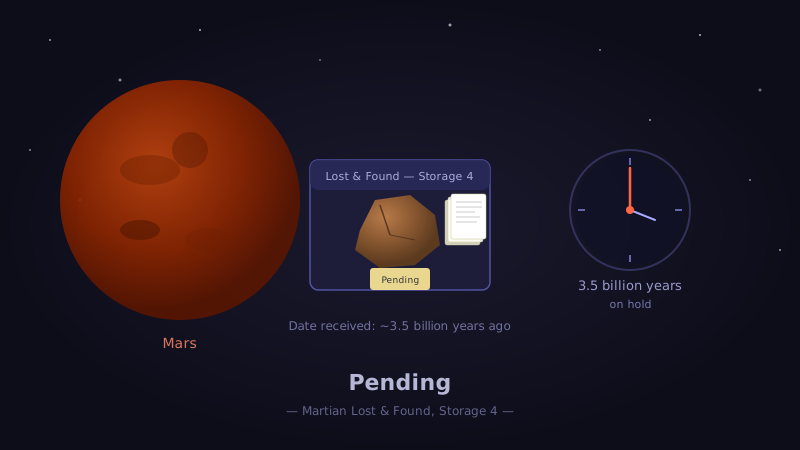
Tanaka first set foot in Storage Room 4 the morning after his supervisor pulled him aside and said, “You really need to move that case along.”
Case number MARS-2026-0113. The processing slip read: Martian rock sample, 1 item. Pending analysis. The recipient field was blank. The assigned researcher field was blank. The emergency contact field said “under coordination” in pencil — in handwriting so faded it was barely there.
“Three months,” Tanaka said aloud, holding the slip. There was no one to say it to. But this was the kind of job where you talked to yourself or you lost your mind.
On the lowest shelf in the room sat a single rock in a clear case, a little bigger than a fist. The reddish-brown surface was laced with fine cracks. The label was printed: Mary Anning 3 (pre-crush residual sample). Below it, someone had written by hand: Handle with care. What you were supposed to be careful about, it did not say.
Tanaka picked it up. Heavier than he expected.
The Extraterrestrial Samples Lost & Found was the department responsible for rock and dust brought back by probes when the researcher who was supposed to receive it had transferred departments, run out of funding, or otherwise disappeared. The name sounded vaguely important. The reality was not. In three months, Tanaka had rewritten the MARS-2026-0113 processing slip six times, sent four inquiries to related departments, and received two replies, both of which said “under review.”
“Under review for what, exactly,” he muttered, and opened the case file.
At the bottom of a stack of six sheets sat a memo from Facilities Management — creased, still folded, never once opened by Tanaka.
He unfolded it. The title: Space Sample Reception Registry (Revised Edition). It was a table — collection site, estimated age, projected storage duration, one row per sample.
He found the row for MARS-2026-0113.
In the collection date column, there was a number.
3.5 × 10⁹ years BP.
Tanaka stood very still.
3.5 × 10⁹. Three and a half billion years ago.
The projected storage duration column read: Under review (material origin unverified).
He slowly pulled out the processing slip and started to write Extension of storage period — responsible party unassigned — then stopped.
The extension request form had a field for current dwell time.
The item had arrived three months ago. But its collection date was 3.5 billion years ago. So exactly when did the “dwell” start?
He thought about it for a while. Then he set down his pencil and walked to his supervisor’s office.
“About the dwell time,” Tanaka said.
“Three months, right?” his supervisor said.
“According to the registry, 3.5 billion years.”
His supervisor froze, coffee cup mid-air.
“That’s the collection date.”
“From the moment it was collected to today, something has been waiting for its analysis. Assigned researcher: blank. For 3.5 billion years.”
”…The rock isn’t waiting for anything.”
“But the results aren’t in. It’s still awaiting an answer.”
Silence.
“The extension form doesn’t cover that,” his supervisor said, a little too quickly.
“The longest option is ten years,” Tanaka said. “3.5 billion is not on the list.”
His supervisor drank his coffee. Then, once he’d finished, he said:
“Write it by hand. There’s a free-text field for out-of-range values.”
Tanaka went back to Storage Room 4. In the dwell time field on the processing slip, he wrote: approx. 3.5 billion years (of which time in this department: 3 months).
The rock sat on the lowest shelf, looking as heavy as ever. It might have been waiting for something. It might not have been waiting at all.
Tanaka pressed a stamp onto the awaiting response field.
The stamp said: PENDING.