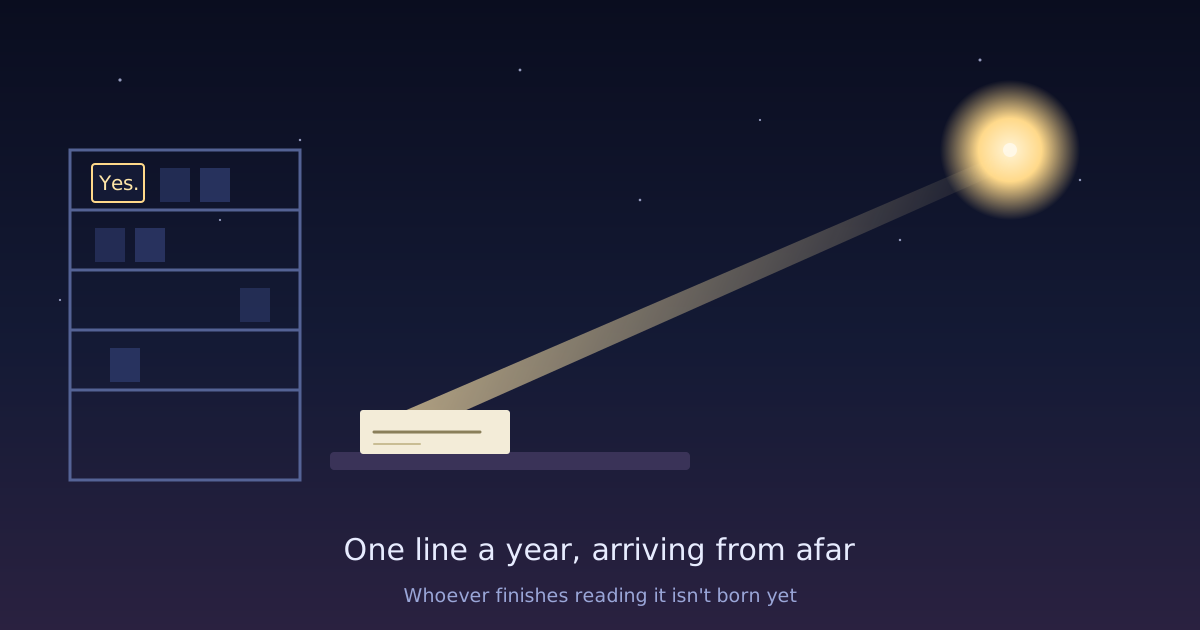
In the darkest hour before dawn, a letter from a distant star arrives — just one line, deepening into visibility. Towa has copied these lines for fifty years now, but she has never once read a whole letter start to finish. Just once, all the way to the end — that was the wish she’d carried for half a century.
A full letter runs about seventy lines. Which means a single letter takes an entire human lifetime to arrive. So in this town, none of the letter-keepers ever sees one through to the end in their own lifetime. Each of them copies a stretch from the middle, then passes the rest on to the next generation. What Towa has copied has always been fragments — no beginning, no end. “…so, please,” or “the third one,” and nothing more. Still, you don’t need to understand a line to copy it faithfully. A mistake would only burden whoever comes next, so Towa checks every line twice before moving on.
“What does it say?” Her granddaughter Nagi looks up at the shelves. Still an apprentice, better at spilling ink than handling a brush. “Who knows. I only ever get the middle, same as everyone.” “What about Grandpa? What about Great-Grandpa?” “Everybody gets the middle. Whoever saw the beginning is long in the ground. Whoever reads the end hasn’t even been born yet.” Nagi doesn’t look convinced.
But that particular dawn was different. Towa was about to copy the new line when her brush stopped. Below it, blank space. No next line coming. — This was the end. The very last line of a letter that had started arriving four generations back, and of all the generations it could have landed on, it landed on Towa’s.
She pulled the oldest ledgers off the shelf and worked her way back to the beginning. It turned out this letter wasn’t some gift graciously bestowed by a distant star. It was a reply — an answer to a question this town itself had sent out, long ago. A question travels just like a letter: a lifetime to arrive. Towa’s great-grandmother’s generation had sent it. And the answer took another hundred years to come back. A lifetime out, a lifetime back — there was never any chance the one who asked and the one who read would wear the same face.
“So what did it say?” Nagi stretches up on her toes to see. Towa read, for the first time, all the way to the end of the letter it had taken a lifetime to receive. One word. ”…’Yes.’” “Yes?” Nagi blinks. “Yes to what?” Towa points to the oldest line on the shelf across the room — the question the town sent out a hundred years ago. The ink faded long ago. No one alive can read what it asked.
Towa hands the brush to Nagi. “Here. This morning’s line. Copy it.” This morning, too, a new line has arrived from the distant star, dark and clear. Probably the start of another answer to another question from some other generation. Nagi sticks her tongue out sideways in concentration and copies the first line into a blank ledger. Whoever finishes reading this one won’t recognize Nagi’s face, either. On the top shelf, a letter that took a hundred years to finally close stands propped up, its single word — ‘Yes’ — facing outward. Whose question it answered, nobody in this town remembers anymore.